
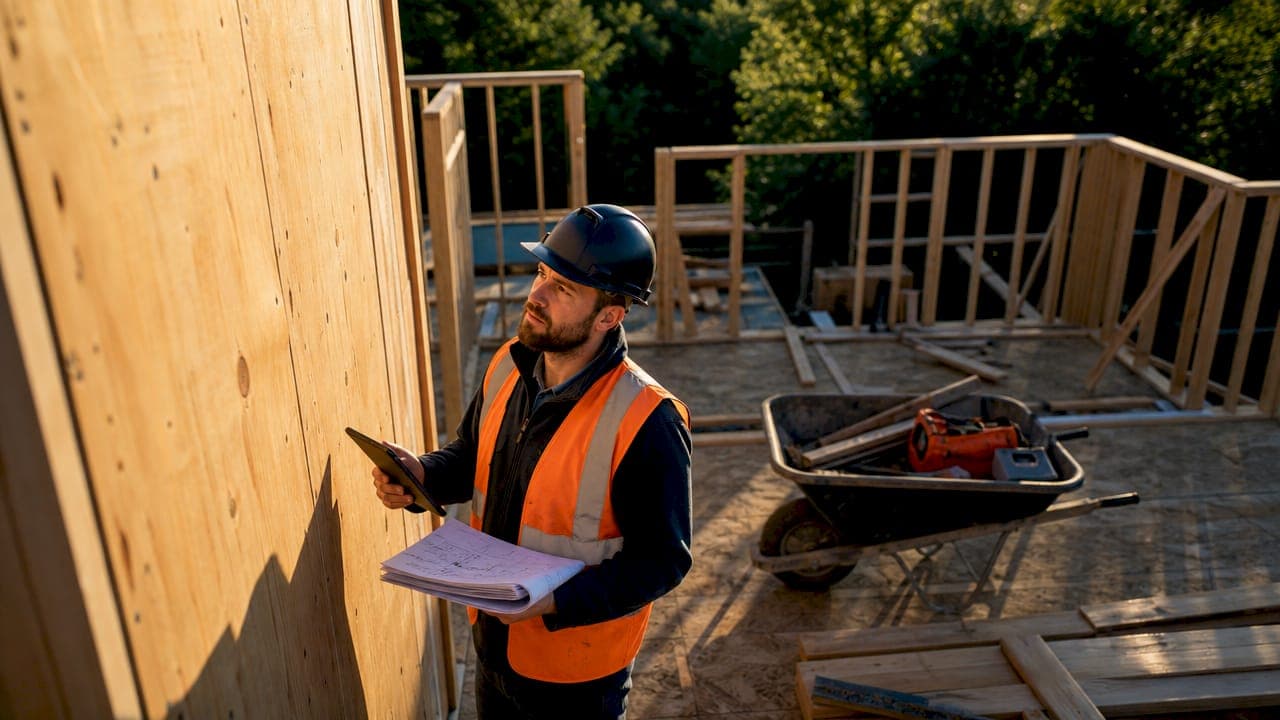
Sheathing is the structural component that transforms a wood-frame wall into a shear wall capable of resisting lateral forces from wind and seismic events. The role of sheathing in shear walls is to create a rigid panel by connecting to the framing, then transfer horizontal loads down through hold-downs and sill plates to the foundation. Primary materials are plywood and OSB meeting APA Rated Sheathing standards, and both must comply with IRC 2024 and IBC requirements for thickness, nailing, and panel grade. Getting these details right is not optional. Shear walls are the last line of defense when a building faces extreme lateral loads.
How does sheathing contribute to lateral load resistance in shear walls?
Structural sheathing converts a flexible rectangular frame into a rigid panel. Without sheathing, a stud wall can rack under lateral load because the framing connections alone cannot resist the diagonal forces. Nailing plywood or OSB to the studs, top plate, and sill plate creates a diaphragm that acts in tension and compression along its diagonals to counteract horizontal forces.
The load path runs from the sheathing face into the edge framing through nails, then into the hold-down hardware at the wall ends, and finally into the foundation through sill bolts and anchor bolts. Every link in that chain must be sized correctly. A weak connection at any point limits the wall's total capacity, regardless of how well the sheathing panel itself performs.
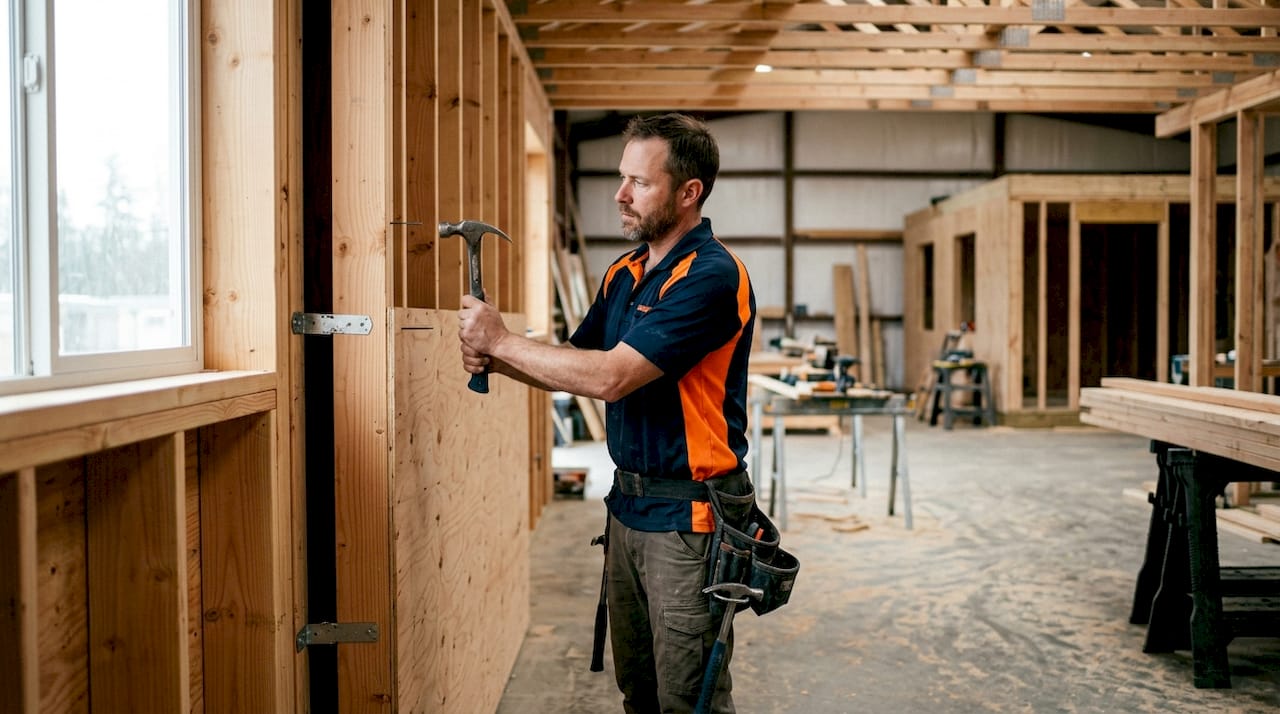
Sheathing thickness and nailing pattern directly set the shear capacity. A 15/32-inch panel nailed with 8d common nails at 4-inch edge spacing delivers 280 plf of shear capacity. Reducing that edge spacing to 2 inches raises capacity to 510 plf. That near-doubling of capacity from one nailing change shows why edge nailing schedules are the most consequential variable in shear wall design.
Plywood vs. OSB: what the data shows
When both carry an APA Rated Sheathing stamp at equivalent thickness and span rating, plywood and OSB perform comparably in shear. The practical difference shows up in moisture exposure. OSB swells at panel edges when repeatedly wetted and dried, which can affect nail bearing over time. Plywood is more dimensionally stable in wet conditions. For engineered shear walls in high-load or high-humidity applications, Structural I rated panels are the correct choice because they meet higher cross-panel strength requirements than ordinary rated sheathing.
Pro Tip: Specify Structural I panels on your drawings whenever you are designing an engineered lateral force resisting system. Using standard rated sheathing in that context is a common reason for plan review rejection.
What are the 2026 code requirements for sheathing installation?
The IRC R602.10 sets the baseline for shear wall sheathing in residential construction. The code mandates a minimum wall sheathing thickness of 3/8 inch, but 15/32 inch is the practical minimum for residential shear walls because thinner panels cannot develop adequate nail withdrawal resistance. Standard nailing schedules call for 6 inches on center at panel edges and 12 inches on center in the field.
Correct installation follows a specific sequence of requirements. Each step affects the wall's final shear capacity and code compliance.
- Select the correct panel grade. Use APA Rated Sheathing for prescriptive walls and Structural I for engineered shear walls. Confirm the grade stamp before installation begins.
- Orient panels correctly. Install panels with the long dimension perpendicular to studs unless the design specifies otherwise. This orientation maximizes bending stiffness across the span.
- Block all panel edges. Blocked shear wall assemblies with solid lumber backing at all panel edges increase nail withdrawal resistance and allowable shear load compared to unblocked assemblies. Blocking is mandatory for high-load applications.
- Follow the edge nailing schedule exactly. Edge nailing drives shear capacity, while field nails primarily resist out-of-plane wind pressure. Missing or misplaced edge nails are the most frequent cause of shear wall underperformance.
- Maintain nail penetration depth. Fastener penetration into framing must be at least 12 times the nail diameter. For an 8d common nail at 0.131-inch diameter, that means a minimum penetration of approximately 1-9/16 inches into the framing member.
- Leave a 1/8-inch gap between panels. Panel expansion gaps prevent buckling when OSB or plywood absorbs moisture. Omitting these gaps can compromise planar stiffness and damage finishes.
- Set nail depth correctly. Over-driven nails crush wood fibers and eliminate nail head bearing. Adjust pneumatic nailer pressure before starting each wall.
Pro Tip: Walk the wall after nailing and run your hand across every nail head. A nail that sinks below the panel face has lost its bearing capacity. Reset your nailer and replace any over-driven fasteners before the inspector arrives.
How do inspectors verify sheathing compliance during framing inspections?
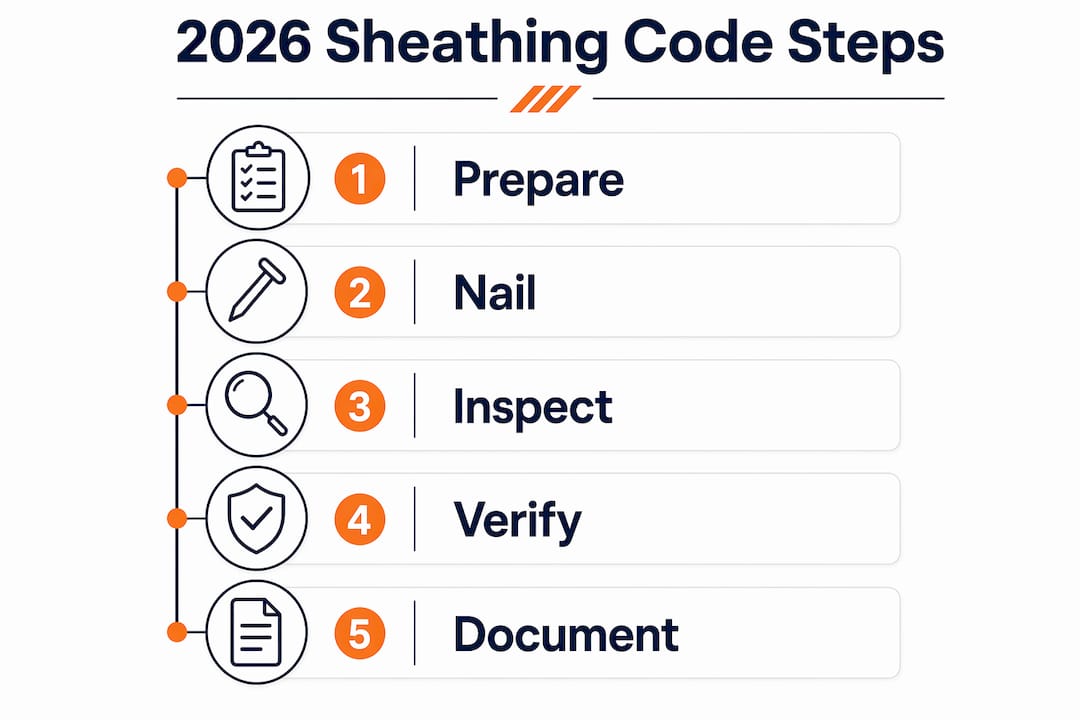
Inspectors check shear walls against the approved engineered plans before any finishes cover the framing. The inspection window is short, and corrections after drywall installation are expensive. Knowing exactly what inspectors look for helps you prepare the wall correctly the first time.
Key items on a framing inspection checklist for shear walls include:
- Nailing pattern verification. Inspectors measure edge nail spacing with a tape and compare it to the approved plans. A single missed nail in an edge zone can trigger a correction notice.
- Nail penetration depth. Inspectors probe nail depth to confirm the 12-times-diameter minimum is met. Shallow nails and over-driven nails both fail this check. Shiners, nails that miss the stud entirely, must be corrected because they provide zero structural contribution.
- Panel thickness and grade stamp. The APA grade stamp must be visible and match the specified panel. Inspectors will reject unlabeled or incorrect-grade panels.
- Hold-down hardware. Inspectors verify that hold-down anchors match the engineering specifications in size, bolt diameter, and embedment. A sample shear wall report from Shearwisepro shows exactly how hold-down forces and hardware specs are documented for inspector review.
- Blocking at panel edges. Inspectors confirm that solid lumber blocking is present at all horizontal panel joints in blocked shear wall assemblies.
- Panel continuity and gaps. Buckled panels or missing expansion gaps are flagged. Panels must lie flat against the framing with consistent 1/8-inch gaps at joints.
The inspection happens once. A wall that fails requires partial demolition of finishes, re-nailing, and a re-inspection. The cost of that sequence far exceeds the cost of getting the nailing right on the first pass.
What are common mistakes to avoid when installing sheathing in shear walls?
Installation quality determines whether a shear wall performs as designed. The panel grade and thickness set the theoretical maximum capacity, but field errors routinely cut that capacity in half or more.
- Treating exterior sheathing as automatic bracing. Continuous sheathing must meet stringent code requirements including blocking, nailing, and hold-downs to qualify as bracing under CS-WSP methods. Simply nailing OSB to studs does not create a code-compliant shear wall.
- Skipping blocked assemblies on high-load walls. Unblocked walls carry significantly lower allowable shear loads. Blocked assemblies are not optional when the engineering calls for them.
- Using standard rated sheathing in engineered systems. Structural I panels are required for engineered lateral systems. Substituting ordinary rated sheathing is a plan review failure and a structural deficiency.
- Ignoring edge nail spacing in favor of speed. Framing crews sometimes nail at field spacing across the entire panel to save time. This eliminates most of the wall's shear capacity.
- Omitting expansion gaps. Panels installed tight against each other will buckle when they absorb moisture, reducing planar stiffness and creating visible damage at finishes.
"Installation quality is more important than nominal panel type. Careful spacing and fastening are necessary to ensure performance." — Industry consensus on shear wall construction
You can use shear wall design software like Shearwisepro to specify nailing schedules, panel grades, and blocking requirements on your drawings before construction begins. Clear, detailed drawings reduce field errors because crews have no ambiguity about what the engineer requires.
Key Takeaways
Sheathing is the primary lateral load-resisting element in wood-frame shear walls, and its performance depends entirely on correct material selection, nailing, blocking, and installation quality.
| Point | Details |
|---|---|
| Edge nailing sets capacity | Reducing edge nail spacing from 4 inches to 2 inches nearly doubles shear capacity per linear foot. |
| Structural I panels are required for engineered walls | Standard APA Rated Sheathing does not meet the cross-panel strength demands of engineered lateral systems. |
| Blocked assemblies maximize performance | Solid lumber blocking at all panel edges is mandatory for high-load shear walls and significantly raises allowable loads. |
| Over-driven nails and shiners fail inspection | Both defects eliminate nail head bearing and must be corrected before finishes are applied. |
| Continuous sheathing needs full detailing | Applying OSB or plywood to studs alone does not qualify as a braced wall line without blocking, hold-downs, and correct nailing. |
Why sheathing details are where buildings actually fail or survive
I have reviewed a lot of shear wall designs over the years, and the pattern is consistent. The engineering on paper is almost always correct. The failures happen in the field, and they almost always trace back to one of three things: wrong edge nail spacing, missing blocking, or over-driven nails from a nailer set too hot.
What surprises most builders is that the panel material matters far less than how it is fastened. A correctly nailed OSB panel outperforms a poorly nailed plywood panel every time. The wood science is secondary to the fastening execution. That is a hard message to deliver on a busy job site, but the physics do not negotiate.
The other thing I keep seeing is the assumption that exterior sheathing automatically creates a braced wall line. It does not. The CS-WSP method under the IRC has specific requirements for blocking, hold-downs, and nailing that go well beyond standard sheathing installation. Engineers need to detail this explicitly, and builders need to read those details. Vague drawings produce vague results.
Software tools like Shearwisepro help close that gap. When the shear wall calculations are organized and the PDF report clearly shows nailing schedules, panel grades, hold-down forces, and blocking requirements, the crew has no excuse for guessing. The inspector has a clear document to check against. That coordination is where the real value of good design software shows up, not just in the math, but in the communication it produces.
Builders and engineers in seismic and high-wind zones cannot afford to treat sheathing installation as a routine task. The shear wall is the building's primary defense against lateral collapse. The details are the defense.
— Evalin
Shearwisepro: shear wall calculations built for real projects
Shearwisepro is a focused shear wall calculator and report platform built for engineers, architects, designers, and builders working on 1-story and 2-story wood-framed projects. The platform organizes wall lines, full-height segments, panel types, nailing schedules, hold-down forces, and blocking requirements in one place, then generates clean PDF reports for review coordination.

When your drawings clearly specify Structural I panels, edge nail spacing, and blocked assembly requirements, field crews and inspectors work from the same document. Shearwisepro produces that document. You can review a sample design report to see how sheathing specifications, hold-down forces, and compliance notes are presented for plan check and inspection. Sign up at shearwisepro.com to run your first project.
FAQ
What is the role of sheathing in shear walls?
Sheathing converts a wood-frame wall into a rigid panel that resists lateral forces from wind and seismic loads by acting in tension and compression along its diagonals. It transfers those forces through edge nails into the framing, hold-downs, and foundation.
What is the difference between plywood and OSB in a shear wall?
When both carry an equivalent APA Rated Sheathing stamp, plywood and OSB deliver comparable shear capacity. Plywood is more dimensionally stable in wet conditions, while OSB can swell at edges with repeated moisture exposure.
What nail spacing is required for shear wall sheathing?
The IRC 2024 standard schedule calls for 6 inches on center at panel edges and 12 inches on center in the field. Reducing edge spacing to 4 inches or 2 inches significantly increases shear capacity per linear foot.
Why do over-driven nails fail shear wall inspections?
Over-driven nails crush wood fibers and eliminate nail head bearing, which removes the fastener's ability to transfer shear load. Inspectors reject them because they do not contribute to the engineered shear capacity of the wall.
When are Structural I panels required instead of standard rated sheathing?
Structural I panels are required for engineered shear walls and diaphragms because they meet higher cross-panel strength standards than ordinary APA Rated Sheathing. Using standard panels in an engineered lateral system is a common cause of plan review rejection.