

A structural calculation package is a comprehensive engineering document that mathematically proves a building project meets safety codes and regulatory standards. Prepared by a qualified engineer with a PE stamp or equivalent certification, it covers everything from load assessments and member sizing to connection details and marked-up site drawings. Engineers, architects, contractors, and building officials all rely on these packages to confirm that a structure safely carries loads and transfers them to the foundation. Understanding what goes into one, and why it matters, is the foundation of any compliant building project.
What is a structural calculation package and what does it include?
A structural calculation package is a formal technical document that demonstrates every load-bearing element in a building is sized and connected correctly. It serves as the bridge between design and regulatory approval. Without it, building departments have no documented basis to issue a permit.
The package typically opens with a design brief. This section states the project scope, applicable codes such as the International Building Code (IBC) or International Residential Code (IRC), material specifications, site conditions, and key design assumptions. Getting these assumptions right matters more than most engineers expect. As the Institution of Structural Engineers notes, structural failures often arise not from math errors but from unexamined assumptions in the design model.

After the design brief, the package moves into load assessments. These cover dead loads (the permanent weight of the structure itself), live loads (occupants, furniture, snow), wind loads, and seismic loads where applicable. Each load type feeds into member design calculations for beams, columns, slabs, foundations, and retaining walls.
Connection and bearing details follow. Bolt patterns, weld specifications, padstones, hold-down hardware, and transfer straps all require explicit documentation. Lateral stability checks and bracing design round out the structural analysis portion. The package closes with marked-up drawings, a revision log, and a PE-stamped summary sheet written specifically for plan reviewers.
Pro Tip: Always include a one-page summary sheet at the front of the package. Plan reviewers often scan this first. A clear summary with load totals, governing code references, and key member sizes can cut review time significantly.
The table below outlines the standard sections found in most structural calculation packages.
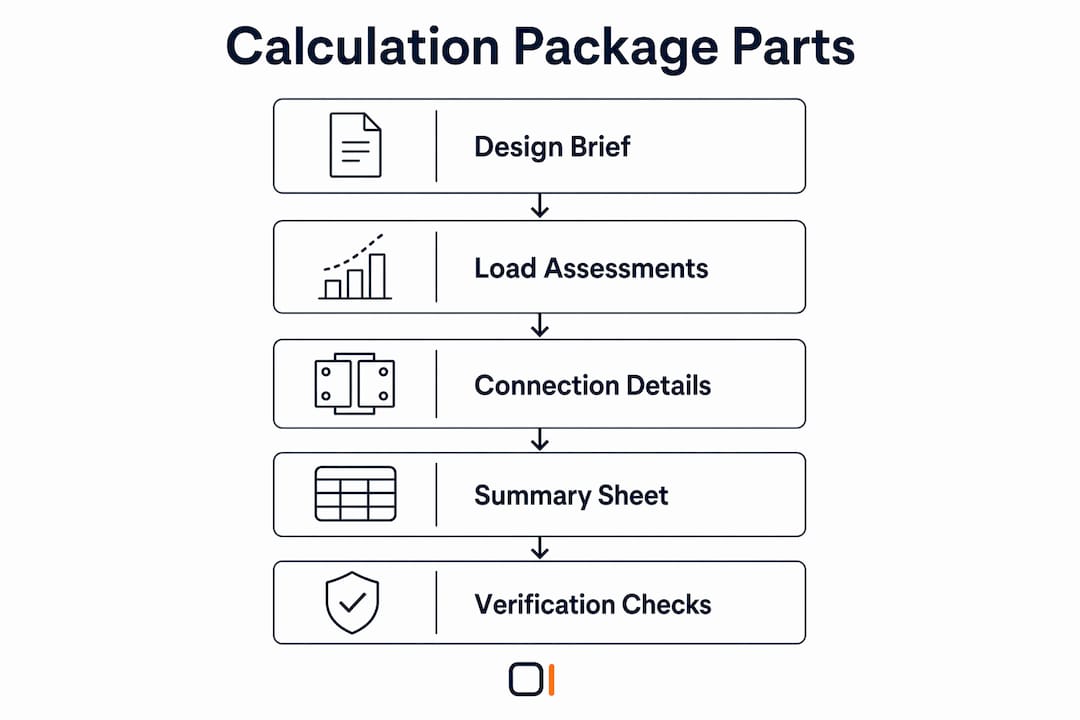
| Section | Purpose |
|---|---|
| Design brief and assumptions | States scope, codes, materials, and site conditions |
| Load assessments | Quantifies dead, live, wind, and seismic loads |
| Member design | Sizes beams, columns, slabs, and foundations |
| Connection details | Documents bolts, welds, hold-downs, and straps |
| Lateral stability checks | Verifies bracing and shear wall adequacy |
| Marked-up drawings | Coordinates calculations with site geometry |
| Revision log | Tracks design changes with dates and reasons |
| PE-stamped summary | Certifies compliance for plan reviewer acceptance |
When and why do projects require a structural design package?
Structural calculation packages are required whenever a project alters load-bearing elements or adds new structural loads. The most common triggers include:
- Removing or modifying a load-bearing wall
- Adding a new floor, loft conversion, or room addition
- Installing large openings in exterior walls
- New construction requiring a full building permit
- Major renovations that change the load path
- Installing heavy mechanical equipment on a roof or floor
The scope of the required package varies by jurisdiction and project type. A simple wall removal might require only a beam calculation and a connection detail. A new two-story wood-framed house requires a full gravity and lateral load analysis, including shear wall design for wind and seismic resistance.
Regulatory requirements also vary. Some jurisdictions accept calculations signed by a licensed engineer without a full package. Others require modular documentation with separate sections for gravity loads, lateral loads, and connection design. Checking local building department requirements before starting the package saves significant rework.
The coordination aspect is equally important. Architects, structural engineers, contractors, and building control officers all interact with the package at different stages. A well-organized document reduces miscommunication and keeps the project on schedule.
Pro Tip: Request a pre-application meeting with the building department on complex projects. Many jurisdictions offer this service. You can confirm exactly what the package must include before you spend time preparing it.
How does structural analysis underpin calculation packages?
Structural analysis is the engineering process of determining internal forces, stresses, and deflections in a structure under applied loads. It forms the analytical core of every calculation package. Without sound analysis, member sizing and connection design have no reliable basis.
For complex projects, engineers use dedicated structural analysis software. SAP2000 and ETABS handle multi-story frames and dynamic analysis. RISA covers a wide range of building types including wood, steel, and concrete. IDEA StatiCa specializes in connection design and verification. Each tool produces output that feeds directly into the package documentation.
Hand calculations remain valid and often preferred for simpler cases. A single-span beam, a point load on a column, or a basic shear wall segment can be checked quickly by hand. Hand calculations are also easier for plan reviewers to follow, which supports faster approvals.
The table below compares when hand calculations versus software analysis is the better choice.
| Scenario | Hand calculations | Analysis software |
|---|---|---|
| Single-span beam or column | Preferred | Unnecessary |
| Multi-story lateral load analysis | Impractical | Required |
| Simple shear wall segment | Preferred | Optional |
| Complex connection design | Difficult | Recommended |
| Seismic response spectrum analysis | Not feasible | Required |
Software does not replace engineering judgment. Calculation models require careful verification beyond automated outputs to catch hidden assumptions and modeling errors. Always check software results against simplified hand estimates. A result that looks wrong probably is wrong.
Pro Tip: Run a quick hand check on at least one critical member from every software model. If the hand result and software result differ by more than 15–20%, investigate before proceeding. Modeling errors are far easier to fix before the package is submitted.
Best practices for preparing and submitting calculation packages
A technically correct package that is poorly formatted will still get rejected. Plan reviewers prioritize clarity, order, and summary documentation over mathematical complexity. Presentation directly affects approval speed.
Follow these practices to produce packages that move through review efficiently:
- Organize by section. Separate gravity loads, lateral loads, and connection design into distinct sections. Reviewers often check only one section at a time.
- Write a load path narrative. A short paragraph explaining how loads travel from roof to foundation helps reviewers understand the design intent without reading every calculation.
- Document all assumptions explicitly. State the unit weight of materials, the tributary areas used, and any simplifications made. Undocumented assumptions are the most common reason for reviewer questions.
- Maintain a revision log. Every design change, whether triggered by site conditions or inspector feedback, needs a dated entry. Revision logs provide a clear audit trail and prevent disputes during inspections.
- Match the calculations to the drawings. Every member referenced in the calculations must appear on the marked-up drawings with the same label. Mismatches create confusion and delay approvals.
- Use consistent units throughout. Mixing imperial and metric units is a common error that undermines reviewer confidence.
- Include code references for every design check. Cite the specific IBC, IRC, or ASCE 7 section that governs each calculation. This shows the reviewer exactly where to verify compliance.
Pro Tip: Number every page and every calculation sheet. Reviewers and inspectors refer to packages by page number. An unnumbered package forces everyone to describe content by section title, which slows every conversation.
The Institution of Structural Engineers treats calculation packages as evidence of professional judgment, not just arithmetic. That framing is worth keeping in mind. Every assumption you document, every load path you trace, and every connection you detail reflects your professional responsibility for the safety of the structure.
Key Takeaways
A structural calculation package is the primary document that proves a building is safe and code-compliant, covering loads, member sizing, connections, lateral stability, and PE-stamped certification.
| Point | Details |
|---|---|
| Definition and purpose | A PE-stamped engineering document that proves structural safety and code compliance for permit approval. |
| Required content | Includes load assessments, member design, connection details, lateral checks, drawings, and a revision log. |
| Project triggers | Required for wall removals, new construction, additions, and any change to a load-bearing element. |
| Analysis foundation | Structural analysis software like SAP2000 or RISA provides the analytical basis; hand checks verify results. |
| Approval success factor | Clear formatting, a summary sheet, and documented assumptions matter as much as correct math. |
Why calculation packages deserve more respect than they get
Engineers sometimes treat the calculation package as an afterthought, something to produce after the real design work is done. That view is wrong, and it costs projects time and money.
The package is where professional judgment becomes visible. Anyone can run a software model. The engineer who documents assumptions clearly, traces the load path explicitly, and formats the package for the reviewer's workflow is the one whose projects get approved on the first submission. That skill is not taught in most engineering programs. It is learned through rejected submittals and frustrated phone calls with building departments.
Software tools have improved dramatically. Platforms like SAP2000, RISA, and ShearWise Pro reduce calculation time and improve consistency. But software output is only as reliable as the inputs and assumptions behind it. I have reviewed packages where the software results were technically correct and the package was still rejected because the engineer never explained why a particular load combination governed, or why a specific wall line was excluded from the lateral analysis.
The engineers who produce the best packages treat documentation as part of the design process, not a separate task. They write the load path narrative while they are still modeling. They update the revision log in real time. They format the summary sheet before the calculations are finished, so they know what the reviewer will see first.
Calculation packages are not bureaucratic paperwork. They are the record of how a qualified professional decided a building would stand safely. That record deserves the same care as the design itself.
— Evalin
ShearWise Pro for shear wall calculations and design reports
Wood-framed residential projects require thorough lateral load documentation as part of any complete structural design package. ShearWise Pro is built specifically for that workflow.
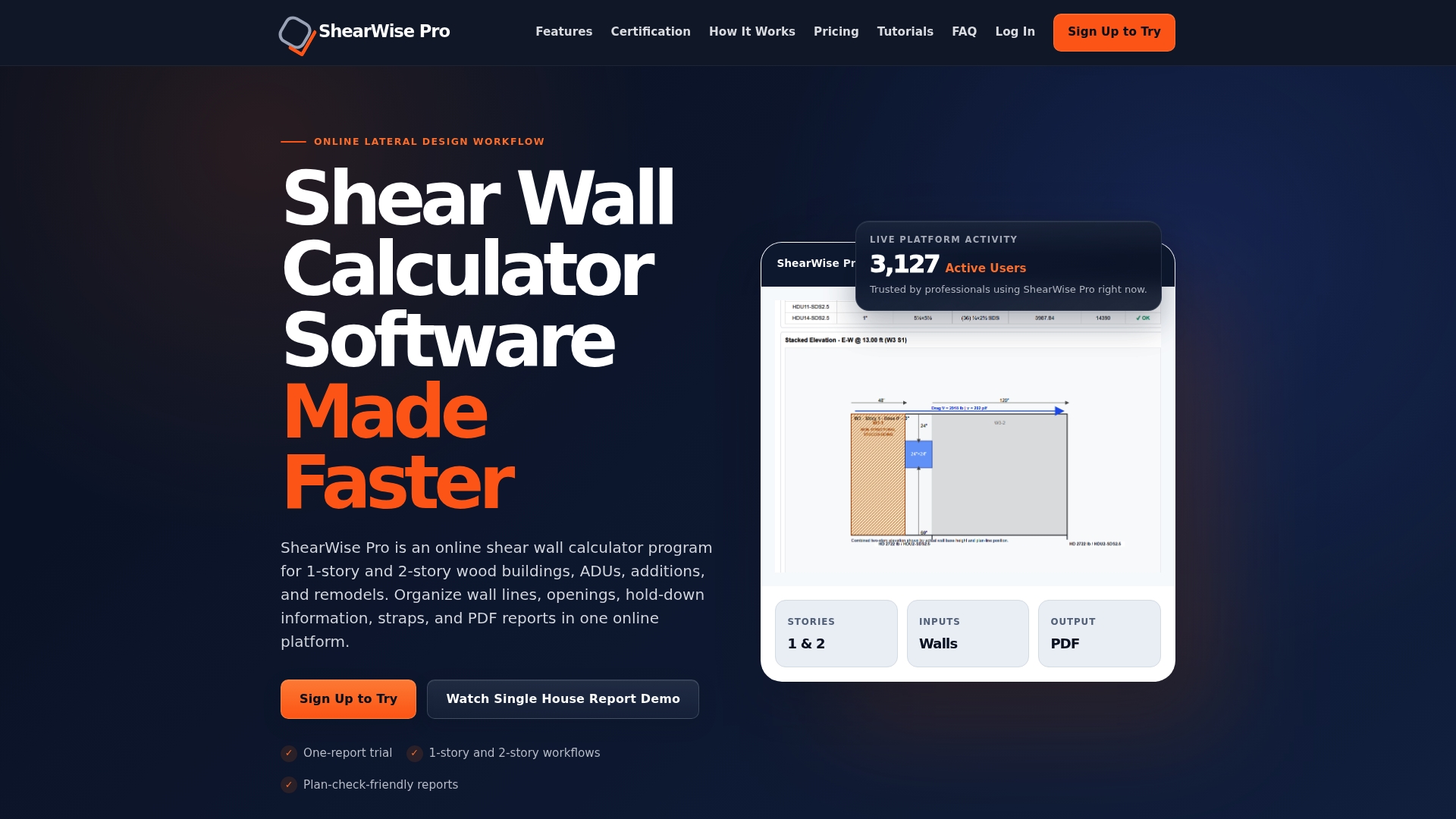
ShearWise Pro handles shear wall calculations for 1-story and 2-story wood buildings, organizing wall lines, full-height segments, hold-down forces, transfer straps, story drift checks, and roof information in one place. The platform generates clean PDF reports formatted for plan reviewer coordination, with the structure engineers need for permit submittals. You can review a sample ShearWise report to see exactly how the output is organized before you commit to the workflow. For engineers and designers who want to produce compliant, well-documented lateral analysis packages faster, ShearWise Pro is worth a close look.
FAQ
What is a structural calculation package used for?
A structural calculation package demonstrates that a building's structural elements are correctly sized and connected to carry loads safely. Building departments require it to issue construction permits.
How much does a structural calculation package cost?
Costs vary widely by project complexity. A simple wall removal may cost around $450, while a full house assessment runs significantly higher. Preparation time typically ranges from several days to a few weeks.
Who prepares a structural calculation package?
A licensed structural or civil engineer prepares and PE-stamps the package. Architects and designers may contribute drawings and design briefs, but the engineering sign-off requires a licensed professional.
What is structural analysis and how does it relate to the package?
Structural analysis is the process of calculating internal forces, stresses, and deflections in a structure. It provides the mathematical basis for every member size and connection detail documented in the calculation package.
Does every building project need a full structural calculation package?
Not always. Minor projects may require only a single beam calculation. New construction, major renovations, and any change to a load-bearing element typically require a complete package covering gravity loads, lateral loads, and connection design.