

Wood framing lateral systems are structural components that resist wind and seismic forces to stabilize 1- and 2-story wood-frame buildings. The industry standard term is "lateral force resisting system" (LFRS), and the types of wood framing lateral systems you choose directly determine whether a structure meets IRC 2024 Section R602.10 and SDPWS requirements. For engineers, architects, and builders working on residential and light commercial projects, selecting the right system depends on building geometry, load demands, and the presence of openings. This article breaks down each system type, its code basis, and the practical trade-offs that matter most on real projects.
1. What are the main types of wood framing lateral systems?
Wood frame lateral systems fall into four primary categories. Each transfers lateral loads through a different mechanism, and most buildings use more than one type working together.
- Braced wall frames. These use diagonal bracing or structural panel sheathing to stiffen wall lines. Methods include let-in diagonal bracing, let-on diagonal bracing, and wood structural panels (plywood or OSB). Braced wall frames are the default system for most 1- and 2-story residential construction under IRC prescriptive rules.
- Engineered shear walls. Designed per SDPWS, these walls carry higher unit shear demands than prescriptive bracing allows. They require explicit calculation of shear demand, panel capacity, hold-down forces, and connection details.
- Diaphragm systems. Floor and roof sheathing act as horizontal load collectors, transferring lateral forces to vertical shear walls. Diaphragms are not optional. Every wood building has them, and their performance limits the entire lateral system.
- Moment frames and portal frames. These are less common in wood construction but appear where wall length is severely restricted, such as at garage openings or large window walls. Portal frames use heavily detailed posts and beams with moment connections to resist lateral loads in a short segment.
Each system has a distinct cost and complexity profile. Braced wall frames are the fastest to document. Engineered shear walls give you the most flexibility. Diaphragms are always present and always need to be checked.
2. IRC 2024 prescriptive bracing methods for wood-frame lateral systems
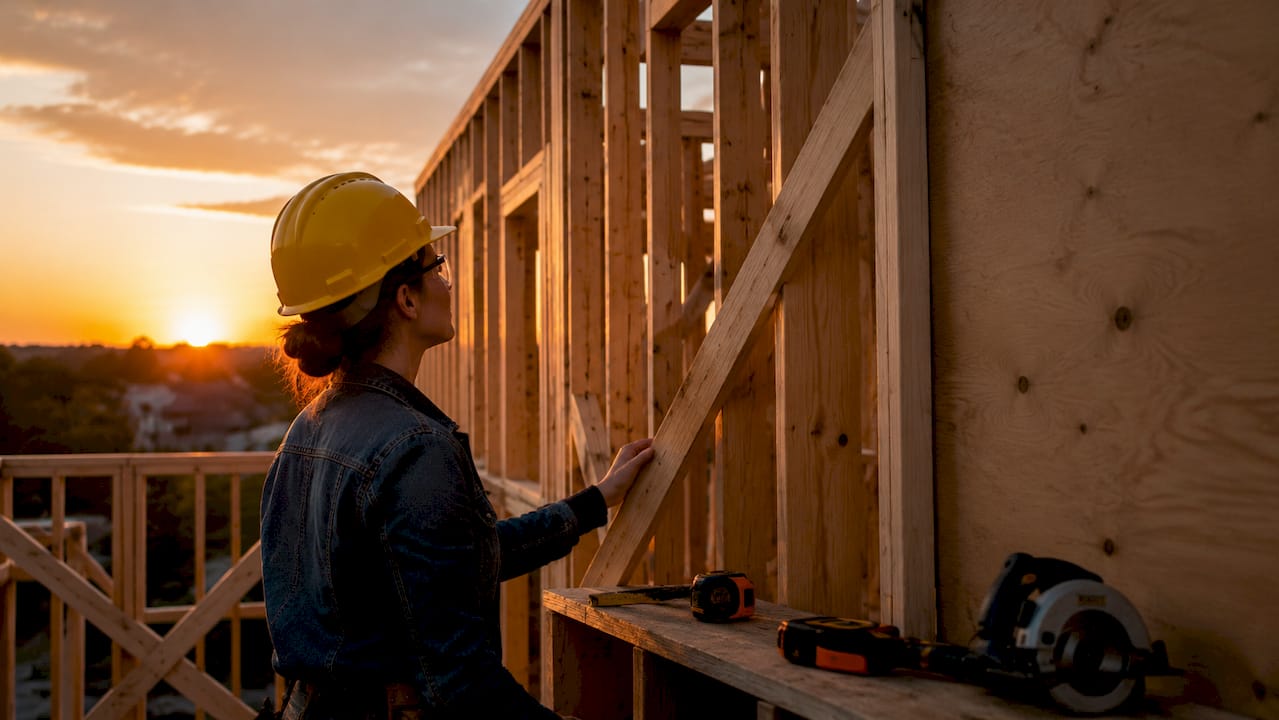
IRC 2024 Section R602.10 defines nine distinct bracing methods for residential wood-frame construction. Methods 3 (wood structural panels) and 9 (stucco on lath) dominate modern use. That concentration matters because most plan checkers and inspectors are most familiar with Methods 3 and 9, which reduces review friction on typical projects.
| Method | Description | Typical Panel Width | Notes |
|---|---|---|---|
| 1 | Let-in diagonal bracing | N/A | Rarely used in new construction |
| 2 | Diagonal boards | N/A | Limited to low-seismic areas |
| 3 | Wood structural panels (WSP) | 48 in. minimum | Most common; high shear capacity |
| 4 | Fiberboard sheathing | 48 in. minimum | Lower capacity than WSP |
| 5 | Particleboard sheathing | 48 in. minimum | Limited availability |
| 6 | Portland cement plaster | 48 in. minimum | Moderate capacity |
| 7 | Hardboard panel siding | 48 in. minimum | Proprietary products |
| 8 | Structural fiberboard | 48 in. minimum | Niche applications |
| 9 | Stucco on lath | 48 in. minimum | Common in California and Southwest |
The alternate method CS-WSP (continuous wood structural panel sheathing) is a significant design tool. CS-WSP allows panels as narrow as 16 inches when hold-down anchors are provided, compared to the standard 48-inch minimum. That 16-inch option is critical on elevations with large windows or doors where full-width panels simply do not fit.
Prescriptive bracing works as a cookbook approach for typical 1- and 2-story homes. You follow the table, confirm your bracing amounts and locations, and document compliance. No unit shear calculation is required. That speed is the main advantage.
Pro Tip: When using CS-WSP on a project with large openings, confirm hold-down anchor placement early in the design phase. Retrofitting hold-down locations after framing is drawn is expensive and time-consuming.
3. When engineered shear walls are required
Engineered shear walls are required when a structure exceeds IRC prescriptive limits, including taller buildings, complex floor plans, or high seismic and wind zones. SDPWS governs the design process, requiring explicit calculation of unit shear demand and panel capacity for every wall line.
The triggers for moving from prescriptive to engineered design include:
- Building height or story count outside the IRC prescriptive envelope
- Extensive openings that reduce available wall length below prescriptive minimums
- Irregular plan geometry with offsets, re-entrant corners, or split-level floors
- High seismic design categories (SDC D, E, or F) common in California and Oregon
- Architectural features that concentrate loads on short wall segments
Once you are in engineered territory, the design process requires calculating unit shear demand (pounds per linear foot) for each wall line, then selecting a panel assembly with adequate capacity from SDPWS tables. Aspect ratio is a critical variable. Tall, narrow shear wall segments rock under lateral load, reducing effective shear capacity. SDPWS applies reduction factors to panels with height-to-width ratios above 2:1.
Connection detailing separates adequate designs from reliable ones. Hold-downs anchor the wall against overturning. Collectors transfer diaphragm forces into the wall end posts. Transfer straps carry shear across floor framing between stories. The lateral load path is only as strong as its weakest connection, and that connection is almost always a hardware item, not the sheathing itself.
Force Transfer Around Openings (FTAO) is the engineered approach for walls with large doors or windows. Instead of treating each full-height segment independently, FTAO treats the entire wall as a unit, with straps above and below openings distributing forces around the opening. FTAO typically yields more wall capacity than the segmented approach, which matters when wall length is limited.
Pro Tip: Document your load path explicitly in your calculations. List each element from roof diaphragm to foundation anchor bolt. Reviewers and inspectors can follow it, and you will catch gaps before they become field problems.
4. How diaphragms function in wood lateral systems
Diaphragms act like deep beams, transferring lateral forces horizontally to shear walls. Floor and roof sheathing carry in-plane shear, with the sheathing panels acting as the web and the boundary framing members acting as flanges (chords). Every wood building has at least one diaphragm, and its in-plane shear capacity sets an upper limit on how much lateral force can reach the shear walls.
Diaphragm layout analysis, including discontinuities and collector placement, is critical for distributing lateral forces effectively. Common discontinuities include stairwells, mechanical shafts, and large floor openings. Each one interrupts the shear flow and requires a collector or drag strut to redirect forces around the gap.
Key diaphragm design considerations:
- Chord forces. Boundary members at the diaphragm perimeter carry tension and compression. Size them for the calculated chord force, not just gravity loads.
- Collector design. Collectors (drag struts) connect the diaphragm to shear walls that do not run the full depth of the building. They carry axial forces and need proper splices and connections.
- Nailing schedules. Diaphragm capacity depends on panel thickness, nail size, and nail spacing. Boundary nailing is typically tighter than field nailing.
- Openings. Frame all diaphragm openings with blocking and provide straps or hardware to complete the load path around the gap.
Pro Tip: Check diaphragm aspect ratio. SDPWS limits the length-to-width ratio for unblocked diaphragms. If your diaphragm is long and narrow, you may need to add blocking or use a higher-capacity sheathing schedule to stay within limits.
5. Comparison of wood lateral systems for 1- and 2-story construction
Selecting the right lateral system depends on project complexity, architectural features, and code requirements. The table below compares the primary systems on factors that matter most to engineers and builders.
| System | Complexity | Code basis | Best for | Key limitation |
|---|---|---|---|---|
| Prescriptive bracing (IRC R602.10) | Low | IRC 2024 | Simple 1- and 2-story homes | Limited flexibility with openings |
| Engineered shear walls (SDPWS) | High | SDPWS | Complex layouts, high loads | Requires full engineering calculations |
| CS-WSP alternate method | Medium | IRC 2024 | Designs with large openings | Requires hold-down anchors at narrow panels |
| Portal frames | High | SDPWS / manufacturer | Garage openings, narrow walls | High cost, proprietary hardware |
| Moment frames (wood) | Very high | SDPWS | Extreme opening constraints | Rarely cost-effective for residential |
Prescriptive IRC bracing is effective for simple 1- and 2-story residential buildings. Engineered shear walls provide the flexibility needed for complex designs and compliance beyond the prescriptive scope. The decision point is usually wall length. When you cannot fit enough prescriptive bracing panels on a wall line, engineered design gives you options that prescriptive tables cannot.
Regional context matters. California and Oregon both sit in high seismic zones, and projects in SDC D and above frequently require engineered shear walls even on modest 2-story homes. Architectural offsets and irregular geometries complicate lateral load paths in these regions, requiring detailed attention to shear wall and diaphragm layout. Builders in these states should expect engineered lateral systems to be the norm, not the exception, on most new construction.
Key selection factors:
- Available wall length on each wall line
- Seismic design category and wind exposure
- Number and size of openings
- Story height and building irregularity
- Budget for engineering and hardware
Key takeaways
The most effective wood framing lateral system for 1- and 2-story construction combines prescriptive bracing where geometry allows, engineered shear walls where it does not, and properly detailed diaphragms connecting both.
| Point | Details |
|---|---|
| Prescriptive bracing covers most simple homes | IRC 2024 R602.10 Methods 3 and 9 satisfy lateral requirements for typical residential projects without full engineering calculations. |
| CS-WSP unlocks narrow panel options | Panels as narrow as 16 inches are permitted with hold-down anchors, solving common opening conflicts. |
| Engineered shear walls are required beyond prescriptive limits | SDPWS governs design when building complexity, load demands, or geometry exceed IRC prescriptive parameters. |
| Diaphragms are always part of the system | Floor and roof sheathing transfer lateral forces to shear walls; collector and chord design is not optional. |
| Connection detailing determines system performance | Hold-downs, collectors, and transfer straps define the load path. The weakest connection controls the entire system. |
Why connection detailing is the real test of a lateral system
The lateral system conversations I find most valuable are not about which sheathing panel to specify. They are about the connections. After working through dozens of wood-frame projects, the pattern is consistent: the sheathing gets designed carefully, and the hold-downs get specified correctly, but the collectors get undersized or the transfer straps get omitted at the floor line. That is where systems fail.
Lateral design hinges on connection detailing. From hold-down anchors to shear wall fasteners, every link defines system performance. The engineers who produce the most reliable designs are the ones who trace the load path from roof to foundation and confirm hardware at every transfer point before the drawings go out.
Modern architecture makes this harder. Open floor plans, large glazing, and offset floor plates are all popular, and all of them create discontinuities that require explicit engineering. The architectural complexity in wood framing demands breaking down lateral load paths into in-plane and out-of-plane components while maintaining system continuity. That is not a reason to avoid complex designs. It is a reason to budget the engineering time to do them correctly.
My honest recommendation: treat the lateral system as a single continuous structure from roof to foundation, not as a collection of individual walls. The moment you start designing each wall line in isolation, you lose track of how forces transfer between them. That is when collectors get missed and diaphragm continuity breaks down.
— Evalin
ShearWise Pro: organized shear wall calculations for wood-frame projects
Engineers and architects working on 1- and 2-story wood-frame projects need a way to organize shear wall calculations, wall lines, hold-down forces, and transfer straps without losing track of the load path. ShearWise Pro is a shear wall calculator built specifically for that workflow, covering unit shear demand calculations, full-height segment design, story drift checks, and clean PDF reports for review coordination.

ShearWise Pro aligns with IRC 2024 and SDPWS, so your calculations stay code-compliant without manual cross-referencing. The platform also offers training tutorials and a certification program to help your team get up to speed quickly. If you work on residential or light commercial wood-frame projects and want your lateral calculations organized in one place, ShearWise Pro is worth a close look.
FAQ
What is a wood frame lateral system?
A wood frame lateral system is the combination of structural components, including shear walls, diaphragms, and connections, that resist wind and seismic forces in a wood-frame building. The system transfers lateral loads from the roof and floors down to the foundation through a continuous load path.
What are the most common types of lateral systems in wood framing?
The most common types are prescriptive braced wall frames per IRC 2024 R602.10, engineered shear walls per SDPWS, and diaphragm systems using floor and roof sheathing. Most 1- and 2-story buildings use all three working together.
When is an engineered shear wall required instead of prescriptive bracing?
Engineered shear walls are required when a building exceeds IRC prescriptive limits, such as high seismic design categories, extensive openings, or irregular geometry. SDPWS governs the design process and requires explicit unit shear demand and capacity calculations.
What is CS-WSP and when should you use it?
CS-WSP (continuous wood structural panel sheathing) is an alternate IRC bracing method that allows panels as narrow as 16 inches when hold-down anchors are provided. Use it when standard 48-inch panels cannot fit due to large windows or doors on a wall line.
How do California and Oregon projects affect lateral system selection?
Both states fall in high seismic zones where SDC D and above is common, making engineered shear walls the standard for most new 1- and 2-story construction. Irregular geometries and large glazing typical of California and Oregon designs further increase the need for SDPWS-based engineering over prescriptive IRC bracing.