

California lateral force resisting systems (LFRS) are engineered structural assemblies that protect wood-framed buildings from seismic and wind forces by providing lateral stability and controlled ductility. Under the 2022 California Building Code (CBC) and ASCE 7-22, every wood-framed building in Seismic Design Categories D, E, and F must incorporate a code-compliant LFRS with a continuous load path from roof to foundation. The industry standard term is lateral force resisting system, though you will also see it called a seismic force resisting system (SFRS) in ASCE 7-22. Selecting the right system is the single most consequential structural design decision you will make on a California project.
1. What are the top California lateral force resisting systems for wood-framed buildings?
The ten systems below cover the full range of options available under the 2022 CBC for wood-framed residential and light commercial construction. Each entry addresses structural mechanism, stiffness, ductility, and practical application in California seismic zones.

Wood structural panel shear walls (plywood and OSB)
Wood structural panel shear walls are the most common LFRS in California residential construction. Structural plywood or OSB sheathing is nailed to wood framing to create a diaphragm that resists in-plane shear. These walls offer good stiffness and are cost-effective for single-family and low-rise multi-family buildings.
Gypsum wallboard shear walls
Gypsum wallboard shear walls are permitted under the California Residential Code (CRC) for prescriptive bracing in low seismic demand applications. Their shear capacity is significantly lower than wood structural panels. Engineers rarely rely on them as the primary LFRS in Seismic Design Category D or higher.
Special moment-resisting frames (SMRF)
Steel SMRFs use ductile beam-column connections to resist lateral loads through bending rather than bracing. Pre-qualified connections per AISC 358 are required in seismic regions. Non-prequalified connections are a code violation. SMRFs are common where architectural openings eliminate wall space for shear panels.
Buckling-restrained braced frames (BRBF)
BRBFs use steel core members encased in a concrete or mortar-filled steel tube. The casing prevents buckling under compression, allowing the core to yield in both tension and compression. This produces high ductility with predictable energy dissipation, making BRBFs well suited for taller wood-over-steel podium structures.
Eccentric braced frames (EBF)
EBFs combine the stiffness of a concentrically braced frame with the ductility of a moment frame. A short link beam between brace connections yields first, acting as a controlled fuse. EBFs work well in mid-rise mixed-use buildings where some architectural openings are required.
Concentrically braced frames (CBF)
CBFs use diagonal, chevron, or X-brace configurations to carry lateral loads axially. They are stiffer than moment frames but less ductile. The 2022 CBC limits their use in higher seismic design categories unless special detailing requirements are met.
Conventional prescriptive braced walls
Prescriptive bracing under the CRC is allowed only for conventional wood-framed houses meeting specific geometry and weight limits. No engineering analysis is required, but the method is restricted to simpler structures. Complex floor plans, heavy roofs, or irregular configurations push a project into full CBC engineering territory.
Dual systems
A dual system pairs a moment frame with a shear wall or braced frame. The moment frame must independently resist at least 25 percent of the design seismic force. Dual systems provide redundancy and are required in some high-occupancy or irregular structures under ASCE 7-22.
Cantilevered column systems
Cantilevered columns act as vertical cantilevers fixed at the base to resist lateral loads. They are used in limited applications such as open-front garages or carports. ASCE 7-22 imposes strict height and redundancy limits on this system type.
Diaphragm and collector systems
Horizontal diaphragms transfer lateral forces from floors and roofs to vertical LFRS elements. Collectors, also called drag struts, gather diaphragm forces and deliver them to shear walls or frames. A diaphragm without properly designed collectors will not transfer load reliably, regardless of how well the vertical elements are designed.
Pro Tip: Select your LFRS based on seismic design category first, then building height, then architectural constraints. A wood structural panel shear wall works for most California single-family homes in SDC D. Move to a SMRF or BRBF only when wall space is genuinely unavailable.
2. How engineered shear walls provide seismic resistance in California residential buildings
Shear walls function as vertical cantilevers. They resist in-plane lateral shear forces and the overturning moment those forces generate. Shear walls must form integrated networks transferring forces continuously from roof to foundation. An isolated shear wall with no connection to the diaphragm above or the foundation below provides almost no seismic protection.
The distinction between prescriptive and engineered design matters significantly in California. The CRC allows prescriptive bracing for simple wood-framed houses. The CBC requires full engineering analysis for anything more complex, including irregular floor plans, heavy tile roofs, or buildings in SDC E and F. CBC Section 1613 and Chapter 18A govern foundation and anchor bolt requirements for engineered shear wall systems.
A properly engineered shear wall requires these components working together:
- Structural sheathing panel (minimum thickness and nailing schedule per the shear wall schedule)
- Hold-down hardware at each end of the wall segment to resist overturning
- Anchor bolts connecting the sill plate to the concrete foundation
- Blocking at panel edges to transfer shear between panels
- Collector straps connecting the wall to the diaphragm above
Shear wall failure most often results from poor connection detailing rather than panel strength. A panel nailed correctly but missing its hold-down will rock and slide under seismic loading. The hardware schedule is not a secondary concern. It is the primary concern.
Pro Tip: Check your full-height shear wall segments for both sliding and rocking failure modes independently. Engineers who check only the panel capacity routinely miss hold-down inadequacies that cause real-world failures.
3. Special considerations for challenging sites and retrofits in California
California's geography creates site conditions that require additional LFRS measures beyond standard flat-lot design. Hillside construction, soft-story buildings, and existing structures undergoing seismic retrofit each carry specific code requirements under the 2022 CBC.
Hillside construction presents the most demanding conditions. The Santa Clarita Building Code amendments require primary anchors and diaphragm struts no more than 30 feet apart for slopes steeper than 33.3 percent. These requirements reflect the added overturning and sliding demands on foundations built into sloped terrain. Other California jurisdictions have adopted similar local amendments under the 2022 CBC framework.
Key retrofit and challenging-site considerations include:
- Cripple wall bracing: Neglecting cripple wall bracing is the most common oversight in residential seismic retrofits. Simply bolting the mudsill to the foundation is insufficient. Structural sheathing on the cripple wall is required to prevent collapse.
- Soft-story buildings: Multi-unit residential buildings with open parking at the ground floor require added steel moment frames or reinforced concrete shear walls at the soft story.
- Foundation upgrades: Retrofit shear walls often require new or enlarged pad footings. Typical residential upgrades involve footings ranging from 1 foot 6 inches to 3 feet 4 inches with 3,000 psi concrete minimum.
- Non-structural bracing: Mechanical, electrical, and plumbing components require seismic bracing per CBC Chapter 16. Unbraced non-structural components become projectiles in a major seismic event.
- Documentation: Retrofit projects in high seismic zones require stamped drawings, a lateral analysis report, and a statement of special inspection.
Coordinate lateral system upgrades with your geotechnical engineer before finalizing the foundation design. Soil conditions on hillside and soft-story sites frequently require special foundation solutions that affect shear wall placement and hold-down anchorage.
Pro Tip: On retrofit projects, complete the foundation investigation before designing the new LFRS. Discovering inadequate bearing capacity after the lateral design is complete forces costly redesigns.
4. How to select the right lateral load resistance system for your California project
Selecting the right LFRS is driven by five factors: seismic design category, building height, architectural flexibility, budget, and ductility demand. No single system is optimal for every project. The table below compares the primary systems used in California wood-framed construction.
| System | Stiffness | Ductility | Architectural impact | Typical use |
|---|---|---|---|---|
| Wood structural panel shear wall | High | Moderate | Requires solid wall segments | Single-family, low-rise residential |
| Steel SMRF | Low to moderate | High | Allows open bays | Open-front buildings, podium structures |
| BRBF | High | Very high | Moderate, diagonal members visible | Mid-rise, podium, mixed-use |
| EBF | Moderate to high | High | Link beam limits opening size | Mid-rise, commercial |
| Concentrically braced frame | Very high | Low to moderate | Diagonal members restrict openings | Low-rise commercial, SDC C and below |
| Prescriptive braced wall | Moderate | Low | Requires frequent wall segments | Simple CRC-compliant homes only |
Stiffness and ductility trade off directly. A stiffer system attracts more seismic force but deforms less. A more ductile system absorbs energy through controlled yielding. The 2022 CBC and ASCE 7-22 reward ductility with higher response modification factors (R values), which reduce the design base shear. For most California residential wood-framed buildings, wood structural panel shear walls deliver the best balance of stiffness, ductility, and cost.
Pro Tip: Coordinate your LFRS selection with your foundation engineer before the schematic design is complete. Shear wall hold-down forces drive footing sizes, and late changes to the lateral system can require complete foundation redesign.
Key takeaways
California lateral force resisting systems require continuous load path design, code-compliant connection detailing, and system selection matched to seismic design category.
| Point | Details |
|---|---|
| Code compliance is non-negotiable | The 2022 CBC and ASCE 7-22 govern all LFRS design in California SDC D, E, and F. |
| Connection detailing drives performance | Shear wall failures result from missing hold-downs and anchor bolts, not weak panels. |
| Prescriptive vs. engineered design | CRC prescriptive bracing applies only to simple wood-framed homes; CBC requires full analysis for complex projects. |
| Retrofit demands extra steps | Cripple wall bracing with structural sheathing is required; mudsill bolting alone is insufficient. |
| System selection follows SDC | Match your LFRS to seismic design category, building height, and architectural constraints before finalizing layout. |
Why load path continuity matters more than system type
After years of reviewing lateral designs on California wood-framed projects, the pattern is consistent. Engineers spend significant time selecting the right system type and then underdetail the connections. A wood structural panel shear wall with a complete hold-down schedule, proper anchor bolt spacing, and edge nailing at 2 inches on center will outperform a theoretically superior system with gaps in the load path.
The projects that perform poorly in earthquakes are rarely the ones that used the wrong system. They are the ones where the diaphragm had no collector to deliver force to the shear wall, or where the hold-down was specified but never coordinated with the foundation. I have reviewed retrofit drawings where the engineer added new shear walls on the first floor but left the cripple wall completely unbraced. The new walls would have been useless in a major event.
The 2022 CBC and ASCE 7-22 give you the framework. What they cannot do is force coordination between the lateral designer, the foundation engineer, and the contractor. That coordination is your responsibility. Software like ShearWise Pro helps by keeping wall lines, hold-down forces, and story drift checks organized in one place, which makes it much harder to miss a connection in the chain.
The engineers who produce the most reliable California lateral designs are not necessarily the ones using the most sophisticated systems. They are the ones who treat load path continuity as a non-negotiable constraint from the first sketch to the final stamped drawing.
— Evalin
ShearWise Pro for California seismic design compliance
California seismic design demands organized, code-compliant documentation at every stage. ShearWise Pro is built specifically for residential shear wall design on 1-story and 2-story wood-framed buildings, covering wall lines, full-height segments, hold-down forces, transfer straps, story drift checks, and clean PDF reports ready for plan check submission.
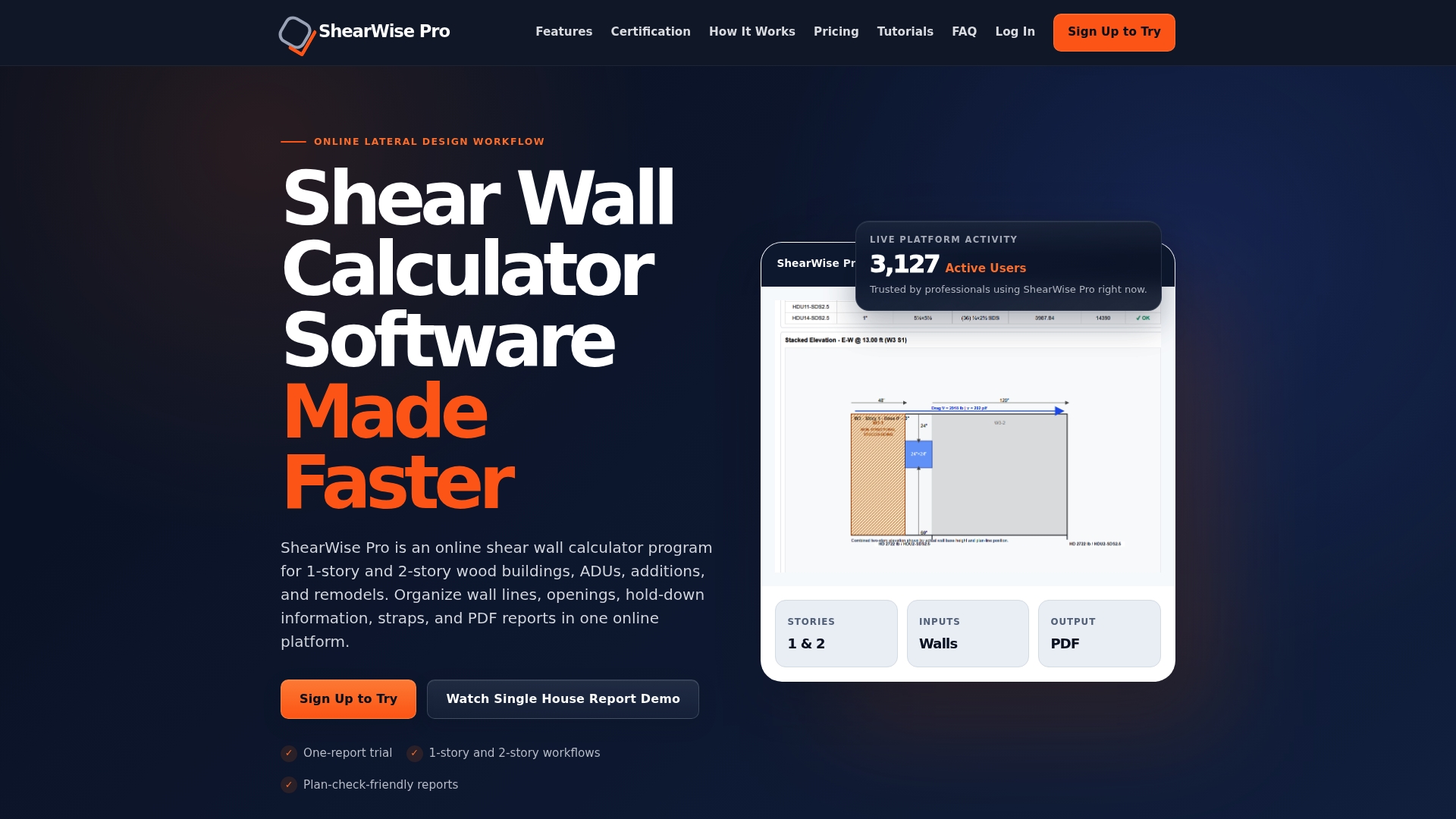
The platform organizes your shear wall calculations in one place, reducing the risk of missing a connection in the load path. Engineers working under the 2022 CBC can generate a complete shear wall design report that documents panel schedules, hold-down hardware, and anchor bolt requirements in a format reviewers recognize. ShearWise Pro also offers certification training for engineers who want a structured workflow for residential lateral design. Sign up and run your first project at shearwisepro.com.
FAQ
What is a lateral force resisting system?
A lateral force resisting system is a structural assembly designed to resist horizontal forces from seismic events and wind. It transfers those forces through a continuous load path from the roof to the foundation.
What code governs California seismic force resisting systems?
The 2022 California Building Code, incorporating ASCE 7-22, governs all seismic force resisting system design in California. CBC Section 1613 and Chapter 18A cover foundation and anchor bolt requirements specifically.
When is a full engineering analysis required instead of prescriptive bracing?
The CBC requires full engineering analysis for any wood-framed building that exceeds the scope of the California Residential Code, including irregular floor plans, heavy roofs, and buildings in Seismic Design Category D, E, or F.
What is the most common cause of shear wall failure in California?
Shear wall failure most commonly results from inadequate connection detailing, specifically missing or undersized hold-downs and anchor bolts, rather than insufficient panel strength.
Do hillside buildings in California require additional LFRS measures?
Yes. Hillside construction on slopes steeper than 33.3 percent requires primary anchors and diaphragm struts, with local amendments such as Santa Clarita's 2025 code requiring struts no more than 30 feet apart.