

Under California law, a digital signature that satisfies Government Code §16.5's five statutory attributes carries the same legal force as a manual signature on engineering documents submitted to public entities. You must confirm your signature is unique to you, verifiable by a third party, under your sole control, cryptographically linked to the signed data, and generated using technology that conforms to Secretary of State regulations. Not every e-signature tool clears that bar. Public key cryptography (PKC) does, which is why it has become the practical default for California engineering submittals.
TL;DR:
- Public key cryptography is the only California-approved digital signature technology that guarantees uniqueness, control, and tamper evidence for engineering documents.
- Jurisdictions are not required to accept digital signatures, so engineers must confirm agency acceptance policies before submission.
- Using shared credentials or signing with an image of a stamp invalidates the signature’s legal standing, regardless of cryptographic validity.
- Export and archive signed PDFs with verification artifacts and certificate details to ensure long-term defensibility during audits.
- Proper key custody, individual certificates, and strict control practices are the most effective measures to ensure compliance and avoid audit failures.
Table of Contents
- Understanding California Digital Signature Engineering Requirements
- PKC vs. Signature Dynamics: Why One Wins for Engineering Work
- What Steps Should Engineers Follow Before Signing?
- Keeping Signed Documents Defensible Over Time
- Questions to Ask Before Adopting a Signing Platform
- Building the Rules Into Your Reporting Workflow
- Where to Verify Current Rules
- Why Most Compliance Advice Undersells the Key-Custody Problem
- Sources
- FAQ
Understanding California Digital Signature Engineering Requirements
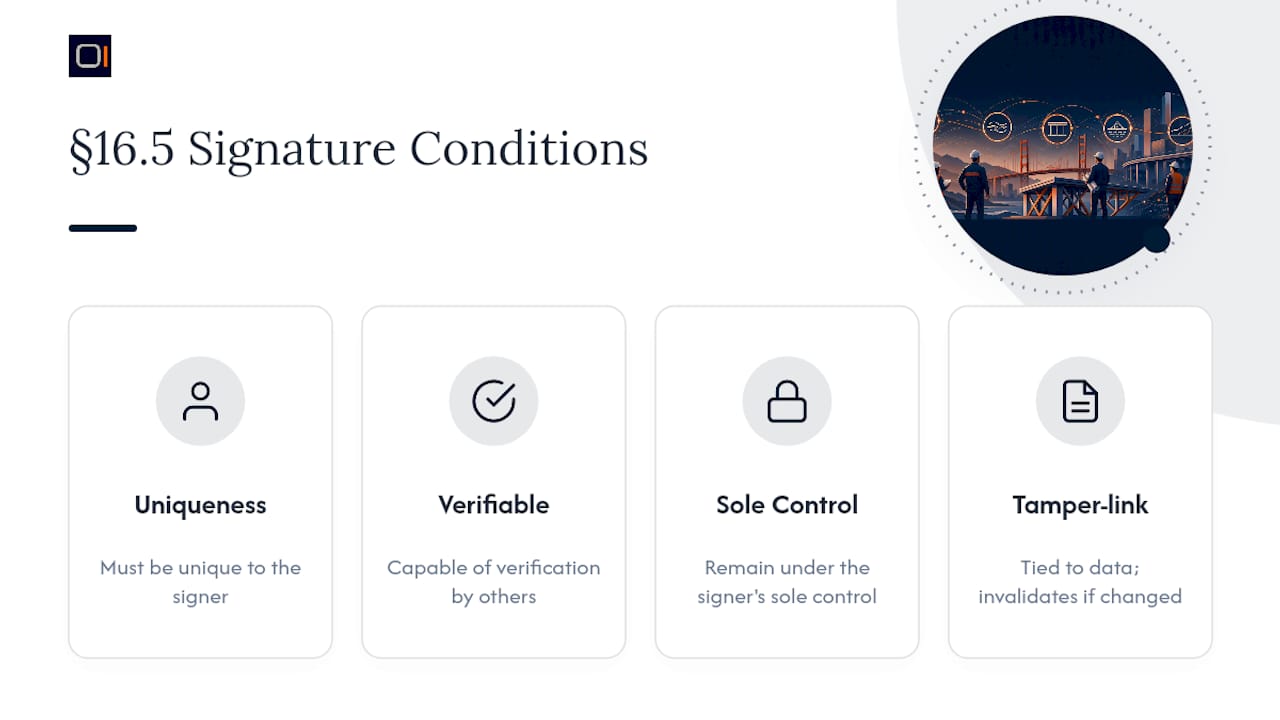
Government Code §16.5 lays out five conditions a signature must meet before it carries the same weight as your wet ink and physical seal. First, the signature must be unique to the person using it. Second, it must be capable of verification by someone other than the signer. Third, it must remain under the signer's sole control. Fourth, it must be linked to the data in a way that invalidates the signature if the document changes after signing. Fifth, the technology producing it must conform to regulations adopted by the Secretary of State.
That last piece is where Title 2 of the California Code of Regulations, Chapter 10 does its work. The regulations define which technologies satisfy the statute and describe how certificate-based systems demonstrate identity and control. The Secretary of State's Division 7 pages walk through acceptable technologies and maintain guidance for verifying certificates issued by approved authorities.
Here's the practical wrinkle engineers often miss: a public entity is not required to accept digital signatures at all. Cities, counties, and special districts retain discretion over whether and how they'll take digital submittals. Before you sign anything destined for a building department or plan check counter, confirm that agency's current policy. Some jurisdictions have detailed digital submission portals; others still want a physical seal on file. Skipping that call can cost you a resubmittal.
PKC vs. Signature Dynamics: Why One Wins for Engineering Work
California regulations recognize two acceptable technology categories for meeting §16.5: public key cryptography and signature dynamics. They work very differently, and the difference matters for how you sign.
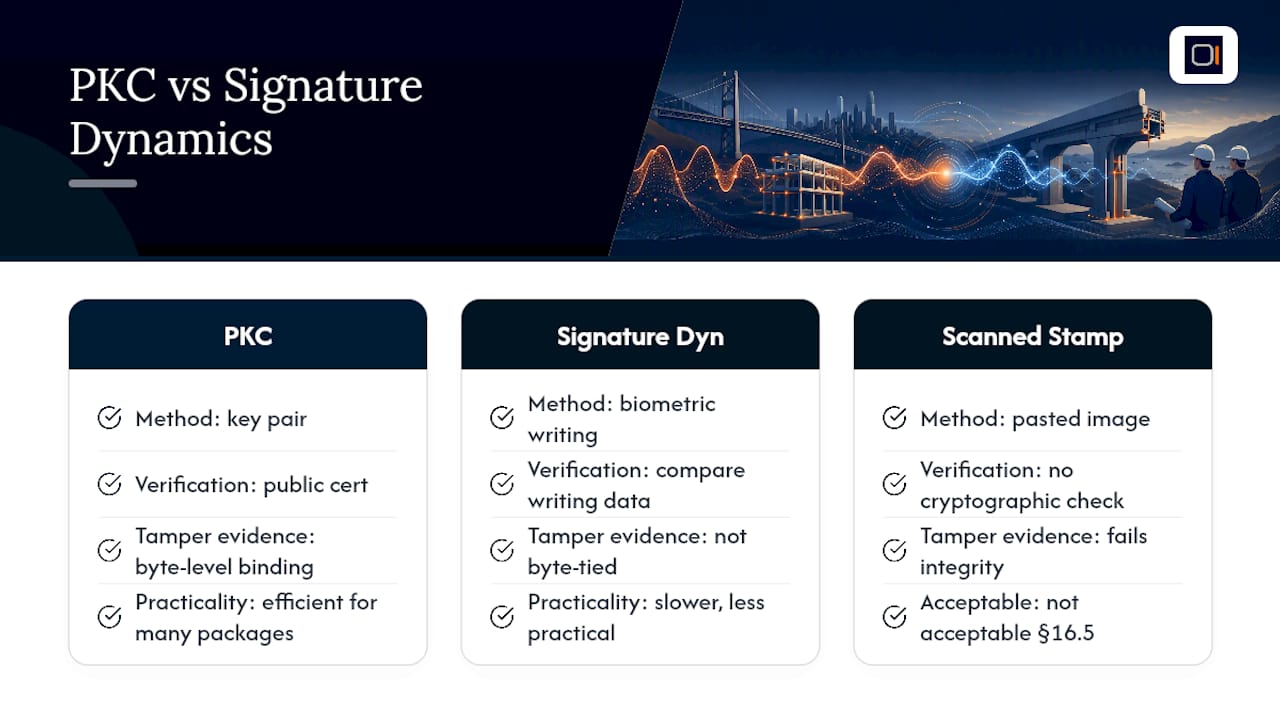
PKC relies on a paired set of cryptographic keys. Your private key, held only by you, generates the signature. Your public key, tied to a certificate issued by an approved authority, lets anyone verify that signature against the document. Because the math ties the signature directly to the exact bytes of the file, any post-signing edit breaks the verification, which is exactly the tamper-evidence §16.5 demands.
Signature dynamics instead measures how you physically write your signature. It's a legitimate acceptable technology under the regulations, but verification requires comparing biometric writing data rather than checking a certificate chain, which makes routine document exchange slower and less practical for engineering firms that submit dozens of packages a month.
One more thing worth saying plainly: a scanned image of your stamp pasted into a PDF satisfies neither category. It carries no cryptographic link to the data, so it fails the integrity requirement outright no matter how official it looks on screen.
What Steps Should Engineers Follow Before Signing?
Compliance isn't complicated, but it does require discipline. Follow this sequence for every public-entity submittal:
- Confirm the agency's acceptance policy. Call or check the jurisdiction's website for its digital submission requirements and any approved certification authority list it references.
- Sign with PKC, not an image. Use a certificate-based signing tool that cryptographically binds your signature to the final PDF rather than layering a stamp graphic over the page.
- Control your private key. Each licensed engineer needs an individual certificate protected by multi-factor authentication. Never share signing credentials across a team, even for convenience during deadline crunches.
- Freeze the file after signing. Export a final, locked PDF and archive the verification artifact (the certificate details and validation confirmation) alongside the project record.
- Document responsible charge. Note who signed, their license number, and the certificate metadata in your project file so the chain of accountability is unambiguous during a board inquiry.
Pro Tip: Set a calendar reminder to check your certificate's expiration date well before it lapses. A signature verified against an expired certificate can create headaches during plan review, even when the signing itself happened while the certificate was valid.
Sole control deserves extra weight here. Sharing a signing login, however common it feels in a busy office, undermines the very attribute §16.5 requires. If a credential is shared, you no longer have a signature unique to one person under that person's exclusive control, and that's the definition the statute is built around.
Keeping Signed Documents Defensible Over Time
The cryptographic link inside a PKC signature is your best defense during an audit. If a file changes after signing, whether from a stray edit or a corrupted export, verification software flags the mismatch immediately. That's the mechanism boards rely on when questions arise about which version of a document was actually reviewed and stamped.
Export signed engineering reports as final, non-editable PDFs rather than working files. Preserve the metadata your signing platform generates: certificate issuer, timestamp, and the verification result at the moment of signing. Keep those artifacts in the same project folder as the drawings and calculations themselves, not in a separate, easily forgotten archive.
For retention, treat the signature certificate record the way you'd treat a calculation package: something a reviewer or licensing board could request years later. Include the certificate authority name, the signing timestamp, and a note on how verification was performed.
Questions to Ask Before Adopting a Signing Platform
Not every e-signature vendor meets California's bar, so vet any platform your firm considers using for public-entity work. Ask:
- Does the platform use PKC with certificates traceable to a certification authority the Secretary of State recognizes as acceptable?
- What identity-proofing process does that certification authority follow before issuing a certificate, and can they provide that in writing?
- How does the vendor manage private key custody, and does it support individual multi-factor authentication rather than shared logins?
- Can a reviewer verify your signature offline, and can the platform export a standalone verification artifact for the project file?
Ask your legal or IT team to run these same questions past any vendor before your firm signs a contract, not after documents are already going out the door.
Building the Rules Into Your Reporting Workflow
A compliant signed report needs more than a valid certificate. It needs a package a reviewer can trust end to end: calculations, drawings, and a signature that ties cleanly to responsible charge. Best practice assigns each certificate to a named, licensed individual, never a shared office account, and logs every signing event with a timestamp.
This is where your reporting tool matters. Structured, exportable PDFs make it easier to keep a clean audit trail because the output stays consistent project after project. ShearWise Pro's report exports organize shear wall calculations, hold-down forces, and story drift checks into a reviewer-ready PDF, giving you a clean document to sign rather than a patchwork of files pulled from different sources.
Where to Verify Current Rules
Regulations change, so verify current requirements directly. The Secretary of State's Digital Signatures pages list approved certification authorities and Division 7 guidance. For board expectations, NCEES model rules and NSPE's state-permission summary cover responsible charge and ethics, and ASCE's policy statement addresses protecting seals from unauthorized use.
Why Most Compliance Advice Undersells the Key-Custody Problem
The regulatory text on digital signatures gets plenty of coverage, but most guidance treats §16.5 compliance as a checkbox exercise: get a certificate, sign the PDF, move on. That undersells the real risk. The attribute engineers most often violate isn't verifiability or data linkage. It's sole control.
Shared logins, borrowed credentials during a deadline crunch, and interns signing under a principal's certificate happen more often than firms admit, and every one of those practices quietly invalidates the signature's legal standing even when the certificate itself is technically valid. A signature that anyone in the office can trigger is not unique to one person, no matter how good the underlying cryptography is.
If you take one thing from this guide, prioritize key custody before you worry about vendor selection or PDF formatting. Get individual certificates issued to each licensed engineer, enforce multi-factor authentication, and treat a shared signing credential the same way you'd treat a shared PE stamp: a professional liability, not a convenience. The technology is solved. Discipline around who touches it is where firms actually fail audits.
— Evalin
Sources
- Government Code section 16.5 :: California Secretary of State
- 22003. Acceptable Technologies. (California Code of Regulations)
- NCEES model rules (August 2024)
FAQ
Are digital signatures legal for engineering documents in California?
Yes, when they meet the five attributes in Government Code §16.5: uniqueness, verifiability, sole control, data linkage, and conformity with Secretary of State regulations. Public entities can still set their own acceptance policies, so confirm with the receiving agency before submitting.
Does a scanned PE stamp image count as a digital signature?
No. A pasted or scanned seal image has no cryptographic link to the document, so it fails the tamper-evidence requirement under SOS regulations. Compliant signing requires public key cryptography tied directly to the file's data.
What's the difference between an electronic signature and a digital signature?
An electronic signature is a broad legal category under federal and state e-commerce law covering anything from a typed name to a click-to-sign checkbox. A digital signature under California's framework is a specific cryptographic implementation that meets §16.5's stricter verification and integrity standards.
How do I verify a certificate on an incoming signed document?
Check the certificate against the issuing certification authority's chain using your PDF viewer's built-in validation or the authority's own verification tool, referencing the Secretary of State's acceptable technology guidance for what a valid chain should show. Confirm the certificate was valid at the time of signing, not just at the time you're checking it.
Can multiple engineers share one digital signature certificate?
No. Sharing a certificate or signing credential undermines the sole-control requirement in §16.5 and can invalidate the signature for public-entity use. Each licensed engineer needs an individual certificate protected by multi-factor authentication.