
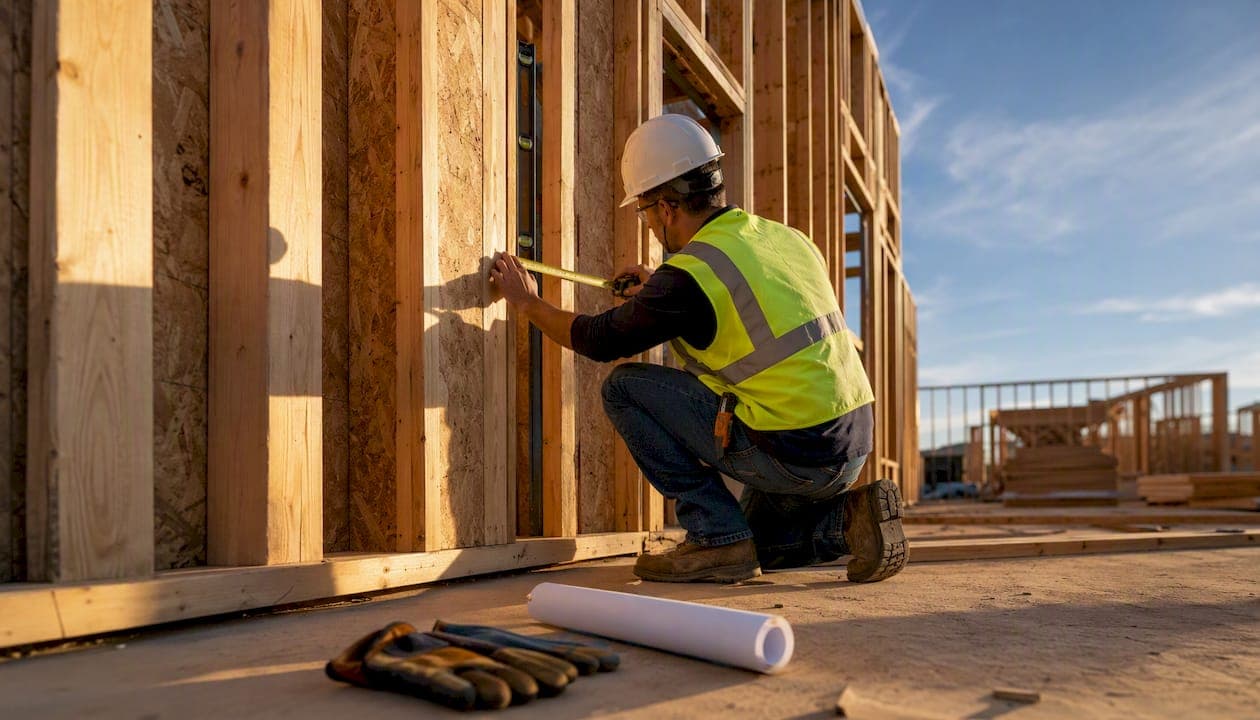
The American Wood Council (AWC) is the nationally recognized technical authority for wood products in the United States, developing engineering data, standards, and education to support safe, code-compliant wood construction. Its core publications — the National Design Specification (NDS), Special Design Provisions for Wind & Seismic (SDPWS), Fire Design Specification (FDS), Environmental Product Declarations (EPDs), online calculators, and continuing education — form the technical backbone that engineers, architects, and code officials rely on daily. AWC codes and standards are developed through an ANSI consensus process and are directly referenced in the International Building Code (IBC) and the broader I‑Codes family.
Key Takeaways
AWC standards are the engineering-mechanics layer that building codes reference for wood design, and using the correct edition with current errata is the single most consequential process step for code compliance.
| Point | Details |
|---|---|
| Match edition to adopted code | Confirm which NDS and SDPWS edition your jurisdiction has adopted before pulling design values or shear capacities. |
| Always check errata | AWC posts errata as separate PDFs; errata can change nominal shear values and footnotes that affect design acceptance. |
| Understand EPD scope | AWC EPDs are typically cradle-to-gate; verify the declared scope matches your green building credit or procurement requirement. |
| Use AWC training for CE credit | AWC offers ICC-, AIA-, and NCSEA-accredited courses on NDS, SDPWS, and lateral design for code officials and design professionals. |
| ShearWise Pro for organized submittals | ShearWise Pro structures AWC-based shear-wall calculations and exports permit-ready PDF reports for 1–2 story wood-framed projects. |
Table of Contents
- What the American Wood Council does: mission, membership, and governance
- AWC's primary standards and what each one covers
- How AWC standards integrate with the I-Codes and local adoption
- AWC calculators and online tools that support your workflow
- AWC Environmental Product Declarations: scope, verification, and procurement use
- AWC training, webinars, and continuing education options
- How to locate, purchase, check errata, and cite AWC documents
- How ShearWise Pro implements AWC shear-wall methods for 1–2 story residential designs
- Why AWC documents matter more than most designers realize
- ShearWise Pro: organized shear-wall calculations aligned to AWC methods
- Sources
What the American Wood Council does: mission, membership, and governance
AWC's mandate covers four interconnected areas: developing technical standards, supporting building code adoption, advancing sustainability disclosures, and delivering professional education. Every major AWC standard goes through a formal ANSI consensus process, meaning that manufacturers, engineers, code officials, and other stakeholders all have structured opportunities to comment before a document is finalized.
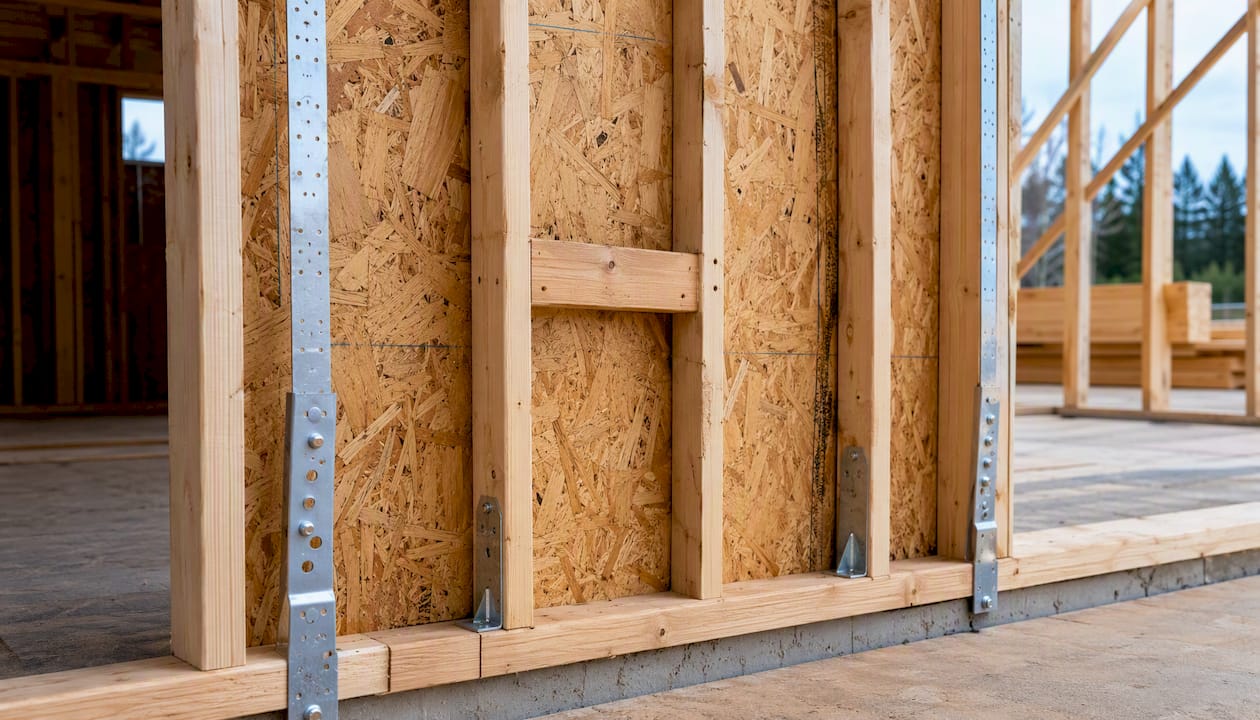
Membership and representation. AWC members are primarily wood products manufacturers and trade associations. That composition shapes which technical problems get prioritized and which data sets drive design-value tables. Knowing this helps you assess where independent peer review adds value alongside AWC's own publications.
How stakeholders participate:
- Submit public comments during ANSI ballot periods for NDS, SDPWS, and FDS revisions.
- Attend AWC technical committee meetings open to industry stakeholders.
- Engage through affiliated associations (e.g., APA, ALSC, ASTM International) that contribute data and review cycles.
- Monitor the AWC website for open comment periods and draft documents posted for review.
The American Lumber Standard Committee (ALSC) plays a parallel role in lumber grading guidelines, overseeing the grading rules and species-specific design values that feed directly into NDS supplement tables. AWC and ALSC outputs are closely linked: NDS references ALSC-approved grading agencies for the design values engineers use in structural wood design.
AWC's primary standards and what each one covers
Each AWC publication targets a specific design task. Using the wrong document — or the wrong edition — produces results that may not align with the adopted code.
| Publication | What It Covers | Typical Application | Common Code Reference |
|---|---|---|---|
| SDPWS (ANSI/AWC SDPWS) | Diaphragms, shear walls, nominal shear capacities, nailing schedules | Lateral force-resisting system design | 2021 SDPWS referenced in 2021 IBC |
| FDS (Fire Design Specification) | Fire-exposed wood members, char-layer calculations, fire-resistance design | Mass timber, exposed beams, fire-rated assemblies | Referenced in IBC Chapter 23 |
| Wood Design Package (WDP) | Bundled NDS + Supplement + Commentary + SDPWS | Complete design reference set for office use | Matches the relevant NDS/SDPWS edition |
| NDS Supplement / Design Value Tables | Species-specific Fb, Ft, Fv, Fc, E values by grade and size | Pulling design values for member calculations | Tied to the same NDS edition |
Edition control is not optional. The 2018 NDS summary of changes documents section-by-section revisions that affect withdrawal values, hold-down provisions, and design-value adjustments. A calculation set built on 2015 NDS tables submitted under a jurisdiction that has adopted the 2018 IBC is technically misaligned, even if the numbers happen to be similar.
How AWC standards integrate with the I-Codes and local adoption
Building codes do not reproduce AWC calculation mechanics. Instead, IBC Chapter 23 and the IRC point to AWC standards by reference, making those documents the engineering layer that backs every code-compliant wood design. The practical consequence: your design is only as current as the AWC edition your jurisdiction has adopted.
Local adoption varies significantly. A jurisdiction may be on the 2018 IBC while a neighboring county has adopted the 2021 IBC, which references the 2021 SDPWS. Mixing nominal shear values from the 2021 SDPWS into a project governed by the 2018 IBC creates a version mismatch that a plan checker can flag. AWC posts errata for current editions as separate downloadable documents; the main PDF does not update automatically when errata are issued.
Pro Tip: Before finalizing any calculation set, run this three-step check: (1) confirm the adopted IBC/IRC edition with the local building department; (2) download the matching AWC standard and check the AWC errata page for that edition; (3) record the edition number, errata date, and any local amendments in your project file. This takes ten minutes and prevents a correction cycle.
AWC calculators and online tools that support your workflow
AWC's resource hub at awc.org provides several tools that fit directly into a design workflow:
- Diaphragm and shear wall design aids: Reference tables and calculation guides that align with SDPWS nominal shear values; useful for quick capacity checks before running full calculations.
- Connection calculators: Tools for common fastener configurations (nails, bolts, lag screws) that apply NDS adjustment factors; appropriate for preliminary sizing, not final design documentation.
- Design value lookup tools: Species and grade-based tables that pull from the NDS Supplement; confirm the supplement edition matches your adopted code before using any value.
- Downloadable spreadsheets and example calculations: AWC publishes worked examples and Excel-based tools for specific connection types and member checks; these are particularly useful for training junior staff on NDS methodology.
- Technical reports and white papers: AWC's technical library covers topics from cross-laminated timber (CLT) fire performance to wind-speed maps; these complement the standards without replacing them.
A calculator result from awc.org is a useful check, but it does not substitute for a full design per NDS or SDPWS when a permit submittal requires documented calculations. Use the tools to verify direction, then produce the formal calculation set from the standard itself.
For wood frame building lateral analysis that goes beyond quick checks, a structured calculation workflow tied to SDPWS shear-wall tables is the more defensible path.
AWC Environmental Product Declarations: scope, verification, and procurement use
AWC's EPD program produces life-cycle assessment-based disclosures for wood products. These documents follow ISO 21930 and the relevant Product Category Rules (PCR), and they are third-party verified through ASTM International as the program operator.
| EPD Attribute | What It Means for Procurement |
|---|---|
| Cradle-to-gate scope | Covers raw material extraction through manufacturing; excludes transportation to site, installation, and end-of-life |
| ISO 21930 / PCR compliance | Confirms the LCA methodology follows a recognized standard, making EPDs comparable across product types |
| ASTM third-party verification | An independent program operator reviewed the EPD against the PCR; not a performance guarantee |
| Validity period | EPDs expire; check the declared validity date before using in a LEED or procurement submittal |
The glulam EPD is a concrete example: it declares cradle-to-gate environmental data for U.S.-manufactured glued laminated timber, identifies AWC as the declaration owner, and lists ASTM International as the program operator. Procurement teams using EPDs for green building credits should confirm that the scope matches what the rating system requires. A cradle-to-gate EPD does not cover end-of-life impacts, which some LEED v4.1 credits require.
AWC training, webinars, and continuing education options
AWC's Learn platform offers live webinars, on-demand eCourses, and multi-day workshops covering NDS, SDPWS, wind and seismic design, and mass timber topics. Continuing education credit is available through partnerships with ICC, AIA, and NCSEA, targeting the audiences most likely to apply the material directly.
- Code officials and plan checkers: AWC's ICC-accredited courses on NDS and SDPWS help reviewers understand the calculation basis behind submitted designs; live webinars often include Q&A with AWC technical staff.
- Design professionals (engineers and architects): AIA and NCSEA credit courses cover structural wood design, lateral systems, and fire design; on-demand formats let you work through material between projects.
- Fabricators and contractors: AWC offers targeted content on connection details, fastener schedules, and wood frame construction best practices; less calculation-heavy, more field-application focused.
- Free access for government employees: Qualifying federal and state government employees may access certain AWC electronic standards at no cost; check the AWC website for current eligibility terms.
- Archived webinars: Past sessions are available on-demand; useful for onboarding staff or reviewing a specific topic without waiting for the next live offering.
How to locate, purchase, check errata, and cite AWC documents
Follow these steps every time you reference an AWC standard in a calculation set or specification:
- Go to awc.org and navigate to the relevant standard page (e.g., the NDS or SDPWS landing page). Confirm the current published edition and any available supplements.
- Download the standard PDF and check the document metadata for the publication date and edition identifier (e.g., ANSI/AWC NDS-2018).
- Check the AWC errata page for that edition. Errata are posted as separate PDFs. The 2021 SDPWS errata is one example of a post-publication correction that can affect nominal shear values and footnotes.
- Note the ISBN or document identifier if provided on the AWC product page; include it in your project file for revision control.
- Record the edition, errata date, and any local amendments in your calculation cover sheet or specification section.
- Use this citation format for plans and reports: American Wood Council. National Design Specification (NDS) for Wood Construction. ANSI/AWC NDS-2018. Leesburg, VA: AWC, 2018. Adjust edition and year to match the adopted version.
- Purchase or access the document. Paid copies are available through awc.org. Qualifying government employees may access certain electronic standards free of charge.
For permit-ready lumber checking workflows, documenting the AWC edition and errata status on the calculation cover sheet is the step most often skipped and most often flagged in plan review.
How ShearWise Pro implements AWC shear-wall methods for 1–2 story residential designs
AWC's NDS and SDPWS define the calculation inputs that any compliant shear-wall design must address. In practice, those inputs map directly to the fields and outputs you work with in a structured software workflow.
From AWC standards to software inputs:
- NDS design values (Fb, Fv, Fc, connection values) feed into member and fastener checks within each wall segment.
- SDPWS nominal shear capacities for specific sheathing and nailing configurations populate the capacity side of each shear-wall check.
- Load combinations (ASD or LRFD per NDS) determine how you apply seismic and wind demands to each wall line.
- Hold-down forces and transfer strap demands come directly from the overturning mechanics defined in SDPWS.
ShearWise Pro organizes these inputs across wall lines, openings, and full-height shear segments for 1-story and 2-story wood-framed buildings. The platform generates hold-down force calculations, story drift summaries, and permit-ready PDF reports that document the calculation basis for plan review. For a detailed look at how wall line analysis applies SDPWS tables across multiple walls, that guide walks through the process step by step.
Pro Tip: Before importing lookup tables or default shear values into any software, verify that the values match the specific SDPWS edition your jurisdiction has adopted and that you have applied any posted errata. Document the edition and errata date in the PDF report before submittal.
Why AWC documents matter more than most designers realize
There is a gap between knowing that AWC standards exist and actually using them correctly. Most plan review corrections tied to wood lateral design trace back to one of three issues: the wrong edition was used, errata were not applied, or the EPD scope did not match what the green building submittal required. None of those are obscure technical failures. They are process failures.
The ANSI consensus process behind AWC standards is genuinely rigorous, but it also means documents change between editions in ways that are not always obvious from the title page. The 2018 NDS changes to withdrawal and hold-down provisions are a clear example: the section-by-section summary exists precisely because the differences matter for calculation outcomes. Treating a new edition as a cosmetic update is the mistake.
On the EPD side, the cradle-to-gate scope is not a limitation to apologize for. It is a defined boundary that makes the data comparable and verifiable. The problem arises when procurement teams use a cradle-to-gate EPD to satisfy a credit that requires a broader scope. That is a documentation mismatch, not a product deficiency.
Professional judgment plus documented AWC methods produces defensible designs. The documentation part is not bureaucratic overhead. It is what lets you defend your numbers when a plan checker or peer reviewer asks.
ShearWise Pro: organized shear-wall calculations aligned to AWC methods
Engineers and designers who work through AWC shear-wall methods manually know the friction: tracking wall segments, openings, hold-down forces, and drift checks across multiple wall lines in a single project takes time and creates version-control risk.
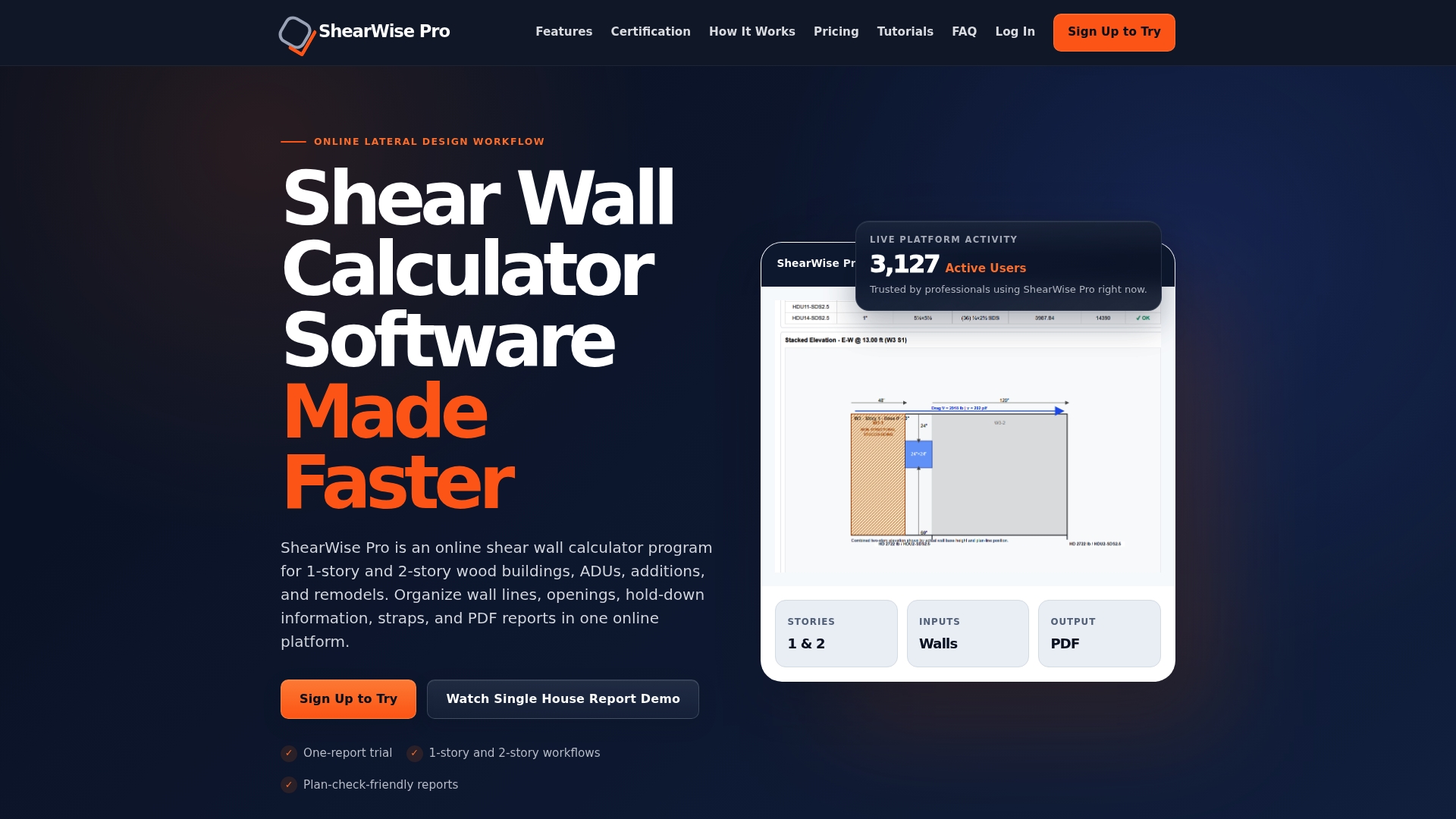
ShearWise Pro is built specifically for 1-story and 2-story wood-framed buildings. The platform organizes shear-wall calculations by wall line, handles openings and full-height segment checks, calculates hold-down forces and transfer strap demands, and exports clean PDF reports formatted for permit submittal. You get a structured, documented calculation set without rebuilding the same spreadsheet for every project. Before final submittal, confirm that the SDPWS edition and errata version used in your calculations match the adopted code in your jurisdiction, and document that edition in the report. Start your free trial with three watermarked reports to see how the workflow fits your practice.
Sources
- About - American Wood Council