

AI for structural engineering already earns its place in a working office: it speeds up early-stage exploration, automates the repetitive parts of documentation, and flags inspection issues faster than a walkthrough. None of that replaces the engineer of record. Every output still needs deterministic verification against code and finite-element results before it touches a stamped drawing. ShearWise Pro is one example of a narrow, verification-friendly tool built for exactly that kind of accountability.
TL;DR:
- AI tools are most effective when exploring design options or automating repetitive documentation tasks, not for final code verification.
- Combining AI-generated proposals with finite-element and code checks significantly improves safety compliance and material efficiency.
- Firms should implement strict templates, retrieval-based data, and audit trails to prevent hallucinations and inaccuracies in AI outputs.
- Starting with narrow, verification-focused tools like ShearWise Pro helps ensure reliability in high-stakes calculations and reporting.
- Building governance with an AI lead, risk logs, and clear success criteria is essential for scalable, safe AI integration in structural engineering workflows.
Table of Contents
- Where AI Already Earns Its Place in Structural Design
- How to Keep AI Outputs Engineering-Grade
- Integrating AI Into Firm Workflows and Toolchains
- Getting Started: A Pilot Checklist Before You Scale
- A Focused Tool Built Around Verification: ShearWise Pro
- Where AI Will Help Engineers Most Over the Next Few Years
- An Alternative Worth Trying: ShearWise Pro for Shear Wall Reports
- Sources
Where AI Already Earns Its Place in Structural Design
The honest answer to "does AI help structural engineers" is yes, but only in specific corners of the workflow. Generative design and topology optimization tools now explore thousands of layout variations for a floor plate or braced frame in the time it takes to sketch three by hand. Generative optimization research frames this correctly: generative AI is good at exploring a wide solution space, while traditional optimization methods refine the handful of promising candidates into something buildable. Use AI to widen the search, then hand the shortlist to a deterministic solver.
Repetitive documentation is the other clear win. Model parsing, calculation formatting, and drawing note extraction eat hours every week, and this is where AI tools for construction workflows genuinely reduce grind rather than replace judgment. A systematic review of AI techniques in structural engineering documents recurring application areas: automated compliance checking, material property prediction, and generative layout tools among them.
Inspection and predictive maintenance for buildings round out the current use cases. Computer vision models trained on crack patterns, corrosion, and deflection now support structural health monitoring programs, catching deterioration between scheduled inspections rather than after a failure.
Where AI helps today, in practical order:
- Generative layout exploration for early massing and lateral system options
- Automated report and model cleanup, including calculation formatting and drawing note extraction
- Vision-based inspection for crack detection, corrosion mapping, and deflection tracking
- Agentic retrieval for pulling firm standards, code clauses, and prior project details on demand
- Early concept screening, reserving deterministic solvers for anything that will be stamped or submitted
The dividing line is simple: use AI when you're exploring, and switch to your finite-element software the moment a decision needs to survive a code review.
How to Keep AI Outputs Engineering-Grade
The single biggest mistake in AI in structural design is trusting a language model to check its own work. Research on closed-loop verification is blunt about this: LLM self-correction is not reliable enough for safety-critical output, and the fix is architectural, not behavioral. Put a deterministic verifier between the AI and the drawing set, every time.
The strongest published pattern right now pairs generation with a finite-element check and a code checker in a repair loop. A design proposal comes out of the model, gets tested against FEA, gets checked against code, and gets sent back for revision if it fails, cycling until it passes.
Closed-loop generation, verification, and repair significantly raised code compliance across multiple test cases, while also reducing material use, according to a verification-driven multi-agent framework study.
That jump, from barely passing half the time to compliant in nearly every case, is the clearest evidence yet that verification loops outperform raw model output by a wide margin.
A related architecture worth knowing is SYNAPSE, a neuro-symbolic design that keeps a deterministic computational core underneath a conversational LLM interface. In a 3Muri chatbot case study, this setup demonstrated high accuracy on a large production test with fast response times, because the language model never handles the actual calculations.
Before adopting any AI tool for structural work, demand three things from the vendor: traceable citations back to code clauses, documented solver accuracy against known benchmarks, and audit logs that show exactly what changed between the AI's draft and the final verified output.
Integrating AI Into Firm Workflows and Toolchains
Machine learning in engineering only pays off when it plugs into tools your team already trusts. That means treating integration as infrastructure work, not a side experiment.
Start with the data. Clean, version-controlled templates matter more than model choice. Firms that see the strongest adoption results are the ones whose AI tools learn from internal templates and project history rather than generic training data.
- Lock your templates first. Standardize calculation formats and drawing conventions before connecting any AI tool, so outputs land in a predictable structure.
- Build retrieval before generation. Retrieval-augmented generation (RAG) grounds an assistant in your firm's actual standards and code editions, which sharply cuts hallucinated parameters. The EngiAI benchmark shows RAG gating meaningfully improves parameter selection accuracy in multi-agent engineering workflows.
- Connect through APIs, not copy-paste. Agent frameworks that orchestrate calls to ETABS, SAP2000, or other FEM solvers keep a traceable data path between the AI layer and the deterministic analysis.
- Preserve the audit trail. Every input and output crossing the AI-to-solver boundary needs a timestamp and version tag, matching the structural calculation package conventions reviewers already expect.
Pro Tip: Run a "known-answer" test file through any new AI connector before trusting it on live work. If it can't reproduce a calculation you've already hand-verified, don't wire it into production.
Common failure modes: hallucinated load parameters, misread units, and gaps between the training data and your region's code edition. RAG and locked templates address most of these directly.

Getting Started: A Pilot Checklist Before You Scale
A pilot works best when it's scoped tightly and measured against numbers you already track, not vague productivity hopes.
- Define scope and success criteria up front, such as a target compliance rate or a material-use benchmark to beat.
- Name an AI lead who owns review gates, a risk log, and the authority to shut the pilot down if outputs drift.
- Run canonical test cases, including at least one project you've already hand-calculated, before letting AI output near production drawings.
- Set a review cadence, weekly at minimum during the pilot, tapering as trust builds.
- Write a short AI usage policy referencing IStructE's AI guidance, which recommends governance steps like risk registers and dataset controls aligned with ISO 42001.
- Train the team, not just the AI lead, so reviewers know what a verified output should look like before they sign off on one.
Small firms without a dedicated AI lead should still appoint someone, even part-time, to own these protocols. Skipping this step is the fastest way to lose track of what got verified and what didn't.
A Focused Tool Built Around Verification: ShearWise Pro
Scope-limited software is one of the clearest ways to see verification-first thinking applied at the project level. ShearWise Pro handles shear wall calculations for 1-story and 2-story wood-framed buildings: wall lines, openings, full-height segments, hold-down forces, transfer straps, and story drift checks.
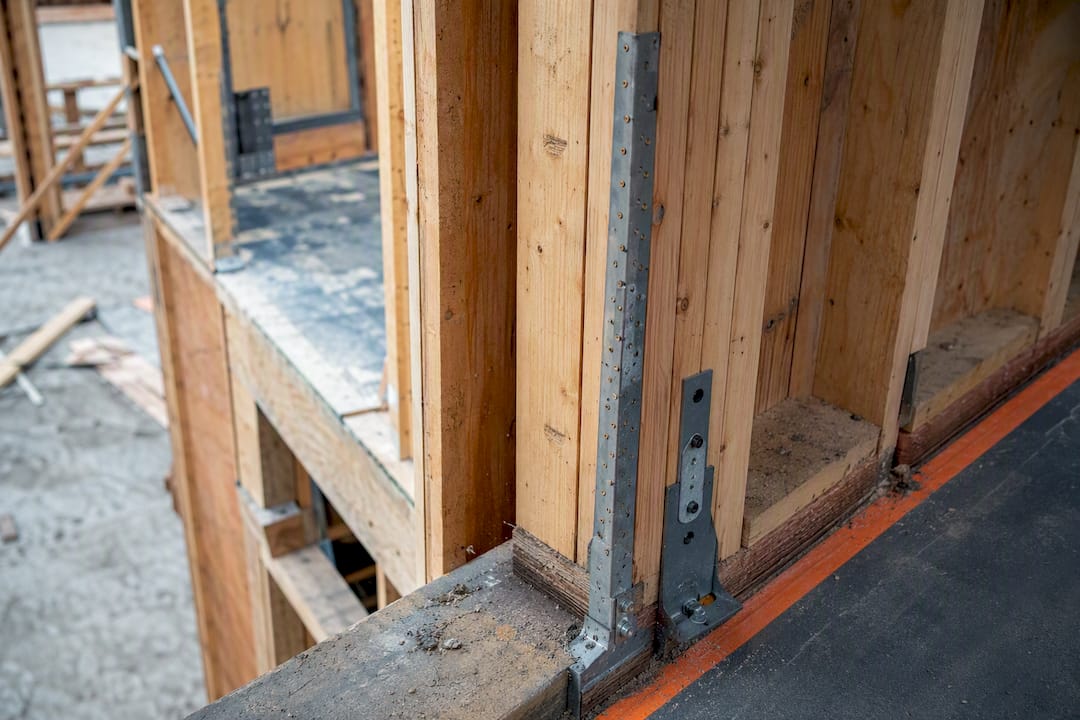
Because the scope stays narrow, every output traces back to a specific input and a repeatable calculation method, producing clean PDF reports built for permit and review coordination rather than open-ended interpretation.
Where AI Will Help Engineers Most Over the Next Few Years
Adoption over the next two to three years will concentrate in three places: generative optimization for early design, agent orchestration for documentation and retrieval, and verification-first tools that keep a deterministic core underneath any AI interface. The firms that get real value won't be the ones chasing the flashiest model. They'll be the ones who build governance first: an AI lead, a risk log, locked templates.
The engineer's role shifts toward supervision. That's not a demotion. Reviewing a verified output against your own judgment is a higher-leverage use of an engineer's time than reformatting a calculation sheet by hand. Start small, test against work you've already hand-verified, and expand scope only after the verification loop earns your trust.
— Evalin
An Alternative Worth Trying: ShearWise Pro for Shear Wall Reports
If your AI experiments still leave you formatting shear wall calculations by hand, ShearWise Pro solves that specific bottleneck without asking you to trust a language model with your stamped output. It's built around the same verification-first logic this article argues for: structured inputs, repeatable calculation methods, and auditable PDF reports rather than open-ended generation.
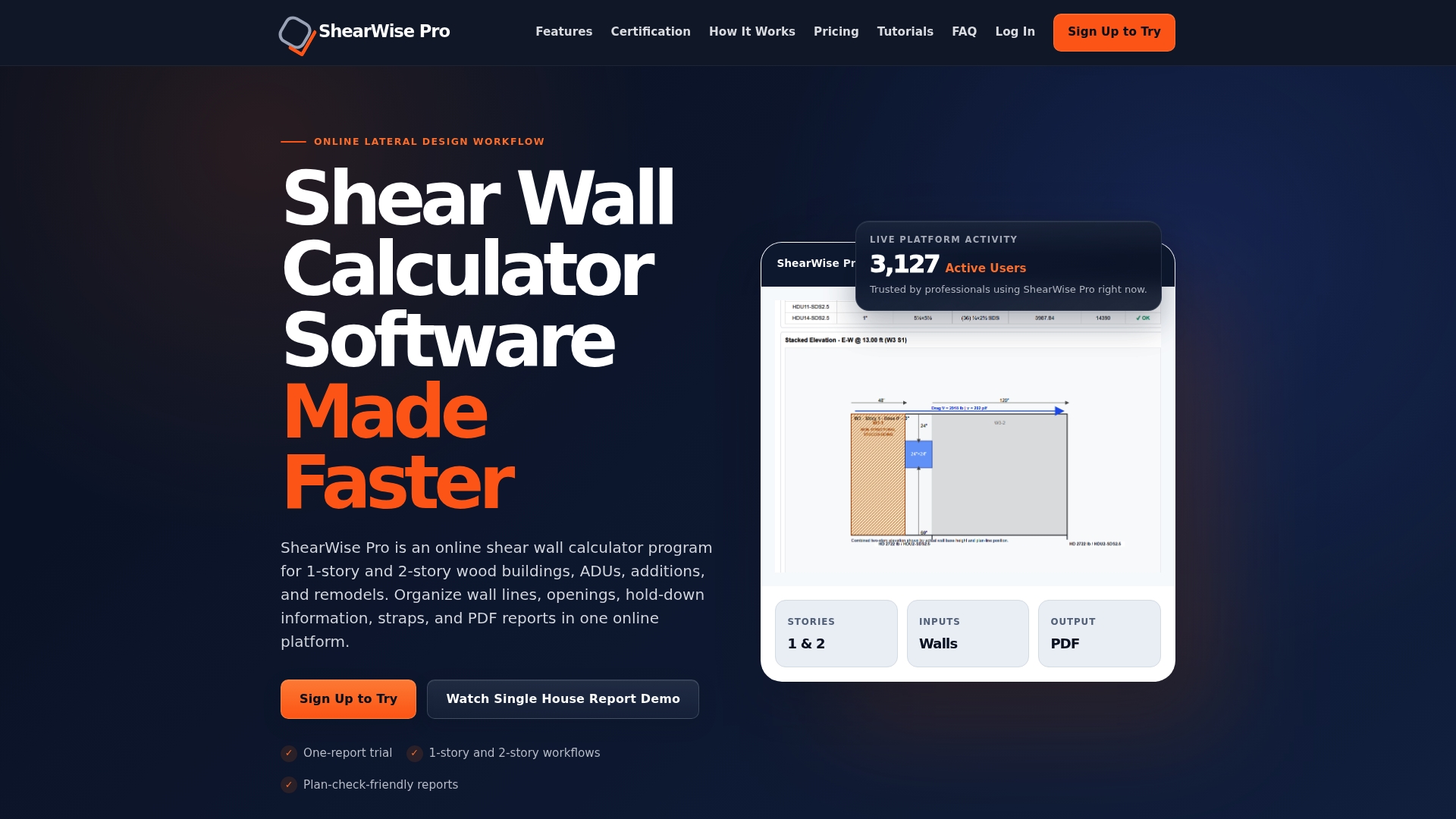
You define wall lines, openings, and full-height segments; the platform handles hold-down forces, transfer straps, and story drift checks, then exports a clean report ready for permit review. For teams working on lateral design software alongside broader FEA tools, ShearWise Pro fills the narrow, high-frequency task those tools weren't built to streamline.
Try the free trial with three watermarked reports on your next 1- or 2-story wood-framed project, or check the tutorial library to see a full workflow before you start.
Sources
- A Neuro-Symbolic Framework for Ensuring Deterministic Reliability in AI-Assisted Structural Engineering: The SYNAPSE Architecture
- Artificial intelligence guidance - The Institution of Structural Engineers
- Generative Optimization: A Perspective on AI-Enhanced Problem Solving in Engineering